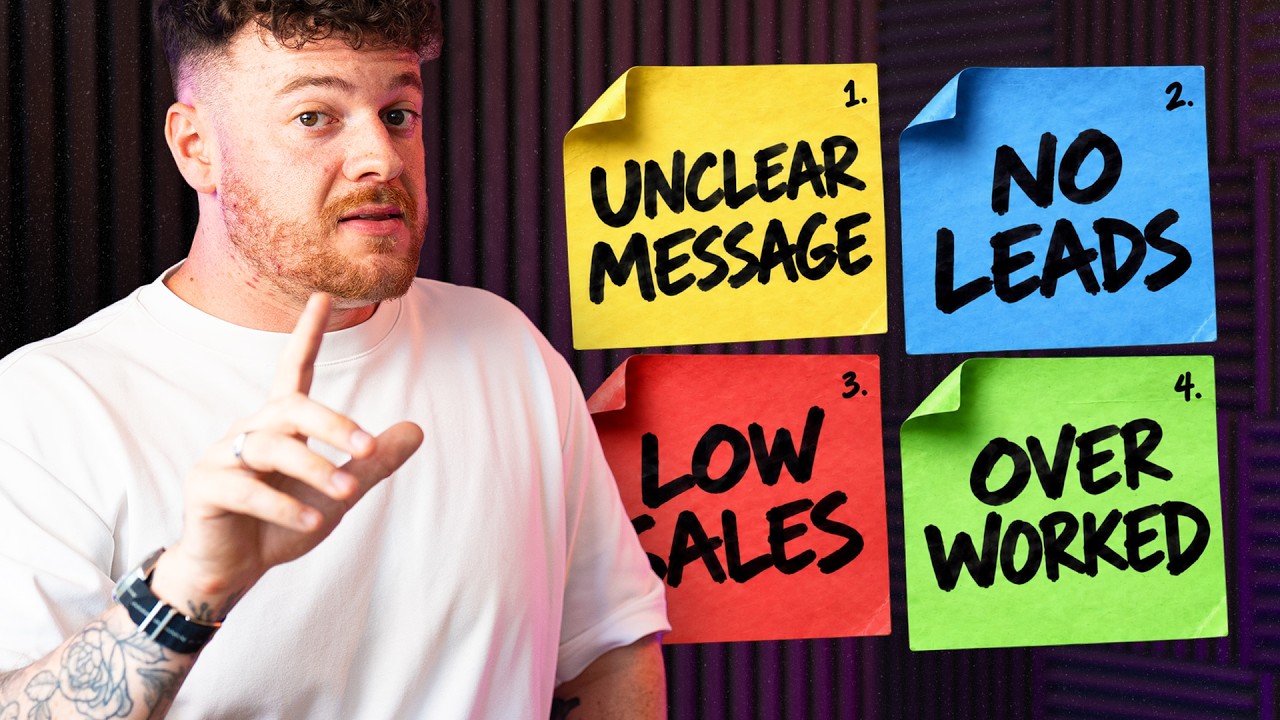
If your business has hit a ceiling, it can feel like there are so many things to fix that you can't decide where to start. I built my last agency to a million pounds a year, and almost every problem I've seen fits into one of four boxes: positioning, marketing, sales and delivery. Fix them in that order.
Positioning: why should I buy from you?
Most small businesses look, feel and sound the same as everyone else in their niche. A local videographer charges £400 to £500 a day and makes much the same thing as the next one. A London agency charges £5K to £10K a month and delivers much the same assets.
Your answer to "why should I buy from you?" isn't "we care about our customers" or "we're award-winning". That's fluff. It's usually hidden in how you actually work: your system, how you deliver, how you onboard people. Look for the point where three things meet:
- what you do exceptionally well
- what your ideal customers want or need
- what your competitors can't or won't do
Marketing: be the one that doesn't sound like AI
What you know doesn't make you unique any more. Anyone can type a question into an AI tool and get a detailed answer in 30 seconds. So most content now looks and sounds the same: AI ideas, AI scripts, AI thumbnails.
What makes you different is experience. Your stories, your mistakes, the things you wish you'd learned ten years ago, your opinions. Then stack in what you love. I'm a car guy, so I film in my car. If you cook, hike or camp, make your marketing there. Nobody can copy that, and it's not quick or easy. That's the point.
Sales: be the doctor
If you're short of leads, go back to marketing. Done well, everything you put out does about 80% of the selling, so people arrive warmed up and want to confirm what they already think. Buyers are checking three things: risk, fit and timing.
Where founders go wrong is offering too much choice. Imagine a doctor who diagnoses you, lists five treatments and asks which you'd like. You'd freeze. Sales calls go the same way, and end with "I'll have a think about it".
Go into every call to help them solve their biggest problem, not to close them. Prescribe one solution and reassure them it's safe. When I made that switch, I closed more than I ever had.
Delivery: get out of the bottleneck
Once the first three are working, you end up stuck doing everything yourself. Try a bottleneck audit. Draw two columns: things only you can do, and things you can hand off. The second list will be much longer.
Over the next 12 months, delegate everything in that second column, starting with the biggest blocks of time rather than the most annoying jobs. Hire well and pay for it. Buy cheap, buy twice. Quality might dip for three to six months, but the time you get back is what lets you work on the business instead of in it.
Want Jack’s eyes on your videos?
Inside The Content Club you get feedback on your videos every week, from Jack and business owners at your stage, and a clear system for turning views into enquiries.
Read the full transcript
If you've clicked on this video, chances are you've hit a ceiling in your marketing, your sales, and generally speaking, your business. It feels like there's so many things that you could go ahead and fix that you're paralyzed by indecision and you don't know what to start on first. I built and grew my last agency to a million pounds of reoccurring revenue every year. And in this video, I want to break down the four biggest business problems that you are likely facing to help you solve them yourself and get things moving properly. The first problem is positioning.
Before you do anything else in your business, you need to solve your positioning problem. Chances are, right now, you run a small business, you are positioned in a market that is very saturated and very competitive along the same lines as everybody else in your niche. Yes, there's going to be slight variations in things like price and branding and messaging and exact offers, but generally speaking, you look, feel, and sound the same as everybody else across the market. For example, I could find a local videographer in my area between four to 500 pounds a day. They're going to create more or less the same stuff.
They're going to shoot on more or less the same cameras. They're going to deliver more or less the same results. I could go and find a marketing agency based in London who charge more or less the same, who deliver more or less the same things. They have slight variations in their offers, but generally speaking, they're going to charge me between five to 10 grand a month and deliver a certain amount of assets by the end. We need to change that.
Okay. We need to change that. How we do that exactly comes down to answering one core question, which is why should I buy from you? Now, this isn't a conversation around because we care about our customers or because we deliver our service with a smile or because we're an award-winning agency. All of that, if I'm going to be candid, is a lot of bollocks.
It's a lot of fluff. Your positioning is deeply rooted in the things that you do day to day. And if you've been running your business for quite a long time, you're going to really struggle to identify what that is unless you take some time to really reflect on it. Okay. And what I mean by that is that your positioning, your messaging, the thing that makes you unique and the thing that makes you, you is often within your system or your service or the way that you deliver your product or your experience or how you onboard your customers or how you delight them along the way.
There's going to be something there intertwined in the day-to-day of what you do that nobody else in your industry does the same way. An example of this is what I do within my own community called The Content Club. First one will be in the description if you want to check it out and apply for yourself. I built this system in The Content Club that is around three different pathways, refinement, marketing, and growth. And whilst we are a community and we offer all the same things that every other community on the planet offers, togetherness, connection, networking, live calls, co-working, etc., we have a system that our members go through that allow them to refine their business, market it properly, and grow it without them being the bottleneck.
Every member goes through this process from the first day that they join and they take things at their own pace without a specific course or an episode one, episode two type of structure. I have found this incredibly rewarding for my members in terms of their results. I have seen firsthand how powerful this system is that we use within the community. And really, up until halfway through 2026 this year, I didn't realize that we were even doing it, to be honest. It was so ingrained in the conversations that I was having behind the scenes and really under the surface, not publicly but privately, that I never really thought that it was something that was substantial enough to differentiate us.
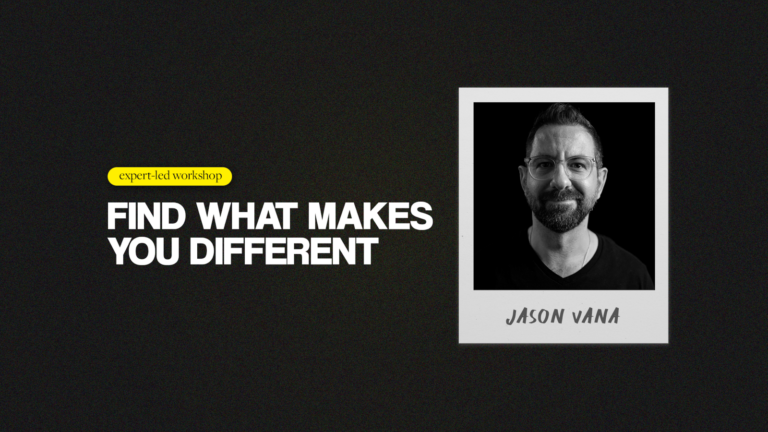
It was only when I had a chat with a messaging consultant called Jason Varna, who we'll get onto in a minute, who really made me realize that actually we have this unique thing. We have a system, an operating system that the community evolves around. And that's essentially what our messaging is now. To break this down even further, I just want to give you a clip from one of the workshops we hosted inside the community a little while ago, from a guy called Jason Varna, who is a good friend of mine and has been for a couple of years. He's an absolute messaging and brand strategy expert.
Okay, take a look at this. Why we do what we do? What makes us different? What makes us unique? What is the story of our business?
How do we do this? We've talked about what is differentiation? That's the theory. How do we get it that you guys can find your differentiator? As I said, it's found at the intersection of what you do exceptionally well, processes, operations, deliverables, what your ideal customers want or need, and what your competitors can't or won't do.
It is at the intersection of what you do exceptionally well, what your ideal customers want or need, and what your competitors can't or won't do. Think about that. This is how you refine or start to refine your position by answering these questions. By simply highlighting the difference in why people should buy from you over other people, it instantly positions you as a slightly different category. No longer are you a commodity in a saturated industry.
You are a unique business that offers something very different, and that's really appealing. I want you to spend some time answering that question, finding the intersection of these points, and really consolidating your positioning as a business before you move on to the next stages. Marketing is the natural next step to think about when your positioning and your messaging and your offer and your pricing, etc. has been developed, refined, and ready to go to market. What I will say here, because there is a level of specificity to this conversation, is that there's a huge conversation that can be had around marketing, and whilst I'm not going to be able to solve the problem for you because I don't know what type of business you run, and every business is slightly different, I'm going to give you the surface level of information that will help you to briefly solve the problem. Marketing, at its core, is about connecting with people, and I feel like we've really lost this over the last couple of years with the addition and the fast-growing nature of AI to do it for you.
Most marketing nowadays is optimized for retention over application. It's optimized for views, reach, click-through rate, watch time, dwell time, you kind of get the idea, over the value that it's delivering for the consumer. What is the purpose of the marketing that we're putting out? Really, marketing should be optimized for application. It should be there to benefit the viewer.
It should be there to support them in solving the problem themselves without you having to do the thing for them. It should be there to delight them, to create an experience that they remember, to create a feeling that they can't wait to tell their friends and their network about. What's also key to remember here in terms of marketing is that we are in the time of information overload, okay? Go back a couple of years, we were in the era of search. Now we're in the era of answer.
In the space of five seconds, right at the tips of my finger, I can type in how to build a marketing strategy for my business. Claude, chat, GPT, other AI tools are available. We'll come up in about 30 seconds with an exact detailed description of what I need to do and how I need to do it. So whilst yes, up until now, relatively speaking, the best tactic has been to give away what you know for free in exchange for leads. Give selflessly, you know?
That's not the case anymore. Information is readily available at the tips of our fingers. So what you know does not make you unique anymore. What does make you unique are the experiences that you create for your audience. It's that feeling of familiarity, entertainment, humor, fear, curiosity, intrigue, playing on these emotional heartstrings.
Touching on raw, tangible human emotion and connecting to them through an experience that you have created within your marketing is what separates you. And chances are, you're probably a really good test of this, right? So I'll ask you, are you tired of consuming content on the feed? If you scroll through LinkedIn, do you get to that point when you think, wow, this is really boring? Or do you scroll through YouTube and think, everything just looks and feels the same?
It just feels so mass engineered for attention. I just don't really know what to do. Yes. Yes is your answer. You do feel like that because I feel like that.
So does everybody else on the planet. Everything today is written through AI. Scripts, video titles, thumbnails are getting designed with the support of AI. Structurally, content is being created through AI. Ideas are being generated through AI, AI, AI, AI.
It is the same old shit done in a slightly different way, but everything looks and sounds the same. Your marketing can be different, but you have to lean into your own experiences. You have to lean into things that only you know, your stories, your learnings, your mistakes, the things that you wish you had learned 10 years ago before you started doing what you do. These things are so important to show because they are built around you. They aren't taken from information that is readily available.
They're taken from real world experience that only you have lived through. Share that more. And whilst it sounds wishy-washy, it's true. If you tell stories from your experience, if you share your perspective, if you challenge people's thinking, you add a bit of controversy, you share a perspective on things, and you start to interest stack, I'll touch on that in a minute, you will start to build marketing that people want to watch. I mentioned interest stacking a second ago.
And what I mean by that is we need to implement things that you are passionate about into your marketing. If you are a petrol head like me, huge car guy, I like to do videos in my car. I can go on a nice drive. I can put my camera in my car, turn it on, rant, and post. And they do really well.
Let's say that you are a lover of cooking. You're maybe a professional chef, or you just have a love for making amazing food. Create your marketing as you're doing a cooking show, as an example. And you like going out for hikes, and you like being in the wilderness and just being in nature because it gives you a chance to breathe. And it feels therapeutic.
Go and film content and go and create marketing whilst you're on a hike, whilst you're outside on a campsite with a blazing fire, a nice cold beer, and a perspective to share. That wasn't scripted. Marketing is not quick, fast or easy. Marketing is hard work. It requires a lot of thought, a lot of cognitive load, we call it.
And you need to use your brain. Because when you use your brain and you come up with ideas, chances are, just because of your experiences and your interests, nobody can create it like you. And that's what's going to allow you to differentiate yourself in a market of people who are doing the same stuff. By all means, go and use AI. But I can guarantee you that your marketing is going to be a little bit crap, and performance won't be great because everybody else is doing the same thing.
In reality, the reason that your marketing is causing a bit of a problem right now is because it's not different. It is the same as every other business in every other industry trying to do the same thing. They're trying to automate. They're trying to make it faster, more convenient, and simpler to do. But in and of that process, you remove the human part.
You remove yourself from that experience. And ultimately, that is what marketing needs. It needs human connection. And if you remove that, you are yet another cookie cutter template, bit of marketing that has been done a thousand times before. That's why it's not working.
The third problem on the list is sales. Now, again, this is going to be specific to different types of businesses, whether you are a recruiter, an agency owner, a leadership coach, a designer, an animator, whatever, a manufacturing company, XYZ. The thing that I would bring it down to in sales is that most business owners are not confident in what they're selling. That comes from a severe lack of strong positioning and strong marketing. Ultimately, sales is about creating belief.
You are the figure that has built this thing, and you don't believe that it can help to solve their problem. You're just going to be pitching all the time, and it's going to go straight over their heads. It's going to fall on deaf ears, and you're going to find that you're not closing enough clients. So you need to feel more confident in your business and the product or service that you sell. And that comes from going back to the grassroots in terms of your positioning, really reflecting on your marketing in terms of how you tell that story.
And when you're on calls, you'll find that naturally you are more confident in what you're selling. For many, unlike yourself right now, if you are running a small business, you'll be sitting there thinking, but Jack, it's not actually a sales problem. It's that I'm not generating enough leads to sell to in the first place. And in that situation, I'd say that's what the second problem is all about. You need to refine your marketing first.
If your marketing is fixed and it's not causing a problem anymore, you will start to attract more of the right types of leads. And that's when you have a sales problem. The way that sales should work in reality is that everything you put out, your website, your content, your marketing, your newsletters, your YouTube channel, the way that you communicate with people in your audience, that should do most of the selling for you. I'd argue about 80%. And your marketing and your brand and your business and the way that you do things should get people to to a point where they are relatively pre-sold and warmed up.
And they just want to have a chat with you to confirm their suspicions. That final 20% is where most founders fuck up the process in a very candid way. They bugger that process up because they aren't confirming suspicions. And really, people are only looking for three different things when it comes to sales. When you're a buyer, they want to know that there is no risk attached to this, that you are a safe choice where their investment is well spent because it's going to get them results.
They want to make sure that you are actually the right fit in terms of likability. There's no point of working with someone that you just don't get on with. So are you the right fit from a personality perspective as well, sometimes, especially as a smaller business. And three, often comes down to timing and logistics. When can we start?
When do we expect results? What's the logistics of the whole process? How much do things cost? Again, they just want reassurance on that part. What tends to happen in sales calls is that you as the business owner will repitch the offer.
When they don't need to be sold to, they just need affirmation, they need confirmation, they need reassurance that what they're about to invest in is the right, logical, safe choice long term. And this authoritative role in this sales call is often lost because you're giving your buyers too much choice. Now, I have watched and I have been on both sides of delivering and taking a bad sales call. And there is a method in sales called the method, which was, I think, created by my very good friend called Richard Moore. I'm going to break it down for you now.
You go to the doctor because you implicitly trust that they are the expert in this situation. But imagine for a second that you went in and they diagnosed the problem and they said, here's five different ways that you could solve it. So what treatment do you think you should take? And they leave you to make that decision. Chances are, in that situation, you're going to be really confused and you're going to be paralyzed by the indecision of, well, what are the positives and negatives of both?
What could the downsides be of this? What could the upsides be of this? What's the logistics of how this works? How long does this one take? How much do these ones cost?
And what's the difference between them? There's too much choice here. And the problem is the doctor in that scenario has given you choice without any context. This happens all the time in sales. You are the expert.
People come to you for the answer to the problem. In most sales calls, you as the founder will say, hey, this is the problem. And here's some solutions that we offer. What would you like to do? And because they don't know what to do, they don't make a decision.
And you're often left with, I'm going to have a think about it. That's the worst thing to hear. Because even actually, they're not going to think about it. They've just gone, I haven't got a fucking clue what you've said. And I don't want to be kind enough to say that I don't want to purchase your thing.
I'm going to go, I'm going to have a think about it. This is the third biggest problem in running a business because you likely started your business because you wanted to do what you love doing. You didn't want to learn the art and the science of selling your product and your service. And it is an art and a science because it is a true mastery of communication. If you can get it right and you can play your cards in the right way, it is incredibly rewarding if you can master your sales.
You started your business because you wanted to make websites or you wanted to coach leaders to become even better leaders within their business or to make amazing videos or to recruit some of the best talent for some of the best businesses. You didn't start your business to sell, especially in the UK as well. So many people are very adverse to selling. It feels icky and it feels maybe a little bit disingenuous as well because we are very humble, maybe in the UK. I don't know.
We don't like to sell so much. We never want to feel like we're pushing people to make a decision. We always want to say, well, you get back to me and I'll give you some space, no pressure, no stress. But in that, we are removing ourselves as the authority in that conversation. And we are saying, hey, you're the expert.
You tell me how you want to do things and I'll be here to say yes to whatever you agree with. In that situation, there is so much trust that is lost between you as the expert and them as the buyer. You are no longer the doctor prescribing a solution in that situation. And that's where sales really starts to unfold. So realistically, my only solid piece of advice for this is position yourself as the doctor in the situation.
Go into every sales call, not expecting to close them and to pitch them and to get them to pay money, but to help them solve their problem. If you go into sales, at least from my experience, I've done a lot of sales calls in my time. If you go into a sales environment and your only goal for that call for 30 minutes, an hour, however long that is, is to help them to solve their most painful problem, you will close more people than you ever have in your life. I can guarantee you it. As soon as I personally shifted to more of a selfless as opposed to a selfish mindset on sales calls, selfless in the sense of I'm here to help you, not to take something from you, the game completely changed.
And whilst that sounds like a scripted buzzword, it really isn't. It has been game changing for my business and it will be game changing for yours. So position yourself as the doctor, reassure them that you are the right choice, confirm that you are not a risky investment and give them the confidence that this solution that you are prescribing is going to get them the results that they want. If you do it in the right way, you will win new business. And coming over to problem number four, delivery.
If you've mastered your positioning, you've mastered your marketing, you've mastered your sales, chances are now you are stuck in the weeds and in the trenches with doing the thing that you do. You are likely in a situation where everything in your business goes through you and you are the bottleneck in most of those scenarios. What you'll end up with is a business where you are 80% in the operations and in the delivery of the service as opposed to what you should be, which is 80% on the business, not in the business. You're stuck in the mud managing clients, you're taking sales calls yourself, you are doing all of your marketing on your own, you are going to meetings and putting pitches together and doing invoices yourself whilst trying to hire people and it just becomes really messy. And at this point in business, a lot of people throw in the towel because it's really hard work.
It's not sexy, it's not fun. It is a point that if you haven't got in already, you will inevitably get to. That's the reality of running a business. It's not all chippy and happy days and sprinkles and glitter. Sometimes it is you are deep in the mud and you have to wade through the trenches to get out to the other side.
So the easiest exercise that I can recommend to you if you are feeling like you're stuck in the delivery stage and you're ingrained in the service of your business and you just can't see the wood through the trees and the light at the end of the tunnel, I want you to do this. I want you to write, I want you to create two columns on a piece of paper. It can be as big or as small as you want. The first column has things that only I can do. The second column has things that I can outsource.
What I want you to do is just spend the next 30 minutes, the next day with your business partner or your friends or your family or your employees, whatever it is, to go through things that only you can do yourself and things that you can get other people to do for you. What you will find is the things that you can do yourself is significantly smaller than the list of things that you can outsource. The premise of this exercise is that over the next 12 months, you delegate all of the things that you're doing that somebody else can do and that you only stay focused on the things that only you specifically can work towards. For example, I am the only person in my business who can have one-to-one consultancy calls with my VIP members within The Content Club. I am the only one in my business who can create my YouTube videos for me.
I am the only one in my business who can be there to host events to make sure that my members have an amazing experience. However, I'm not the only one in my business that can write my video scripts, that can edit my videos, that can post my social content, that can manage my community in terms of nitty-gritty capacity, getting back to comments, replying to posts, those sorts of things. I'm not the only person in my business that can do the accounting. I can hire an accountant. I can hire a bookkeeper who can run my P&Ls, my profits and loss, my bookkeeping, my invoicing, my chasing late payments.
What you want to do is hand off the biggest time blocks first. Not the things that are the most frustrating parts of the process, but the things that will give you back more time once you've outsourced or delegated them to somebody else within your team. In there is then going to be a conversation around hiring, which is an incredibly stressful thing to do if you're inexperienced with it. I have, and I'm not proud of it, hired and fired more people than I can count on both hands. And the reason for that was because I was inexperienced in the art of hiring better people than me.
There's a saying in hiring, which is buy cheap, buy twice. And this rule is so relevant if you're looking to hire people for your business and it feels sensible to get someone on a relatively okay salary, but you know, could always be improved. Don't do that. Hire great people at a premium cost. Whilst it will take them time to get up to speed and to do the things that you do currently really well, chances are they're going to get to about 70 to 80% of the quality standard that you are used to expecting.
But over time, within three to six months, chances are, if you create an environment that allows them to grow and divert their skills, they will exponentially grow better than you at the thing that you're hiring for. And that does come at a premium cost. And whilst in the short term, it feels like a financial hit, longer term, it's going to give you more time back to focus on only the tasks that you can do within your business. And that's going to help you to grow it. The fear with hiring is that if you step out of doing this task, then the quality is going to drop.
And again, I'm going to be real, that's probably going to be the case for at least the first three to six months. But the way that I like to see it is that all the time you are still doing this thing yourself, you are wasting an opportunity to not do it, to spend your time on things that are actually going to move the business forward. So the way that I like to look at it is that, yes, you won't actually take a bit of a quality hit in terms of you're hiring someone to do the thing that you do really well right now. But over time, that will give you more capacity to work on business development, sales, marketing, networking, connecting with people that eventually will want to buy your product and service. You cannot do that until you've delegated, until you've got more time back in your day.
So the solution to this is very simple. And it's to create what I call a bottleneck audit. Two columns, what can I only do myself? And what can I outsource to other people? All of this is with the goal of within the next 12 months to delegate as much of the stuff that you don't need to do yourself to somebody else to get back more of your time to focus on sales, business development, and spreading the word.
I will guarantee you, just from experience, that when you get back more of your time, you can think more clearly about the business. And whilst it will feel painful during that period, it is not a sexy period hiring people and going through cultural shock and having to do new processes and structure. And I've been there, it sucks. But once you're through the thick of it, and once you're through the trenches, and your team are trained up and the quality is back to close to a standard of where you would do it yourself, because you have more capacity, your business will thrive. It will absolutely thrive.
If you've positioned your business properly, if you've marketed it correctly, if you've really mastered your sales process, the delivery is the final part and the only problem that you need to now fix in order to grow your business. Positioning, marketing, sales, and delivery. They are the four biggest problems that I see when running and growing a business. And I want to share my experience here. Whilst I'm not going to be able to solve the problem, because again, it's in the confines of a 10, 20, 30 minute video, this is exactly what we cover inside my community, The Content Club.
It's built for founders who feel like they're the best business that nobody's heard of, and we help them to refine their business, market it properly, and remove themselves from being the bottleneck. If you fancy exploring it for yourself, and maybe joining the next intake of members, applications are currently open, and it'll be in the first line of the description below. If that's not up your street, and you don't feel like it's the right thing for you at the moment, not a problem at all. In the meantime, go and check out some more of my content. It's all free right here on my YouTube channel for you to go and digest and break it all down at your own leisure.
Check it out, and I'll see you there.

Built his last business to £1M a year, then started The Content Club to help business owners turn their expertise into videos that bring in customers.