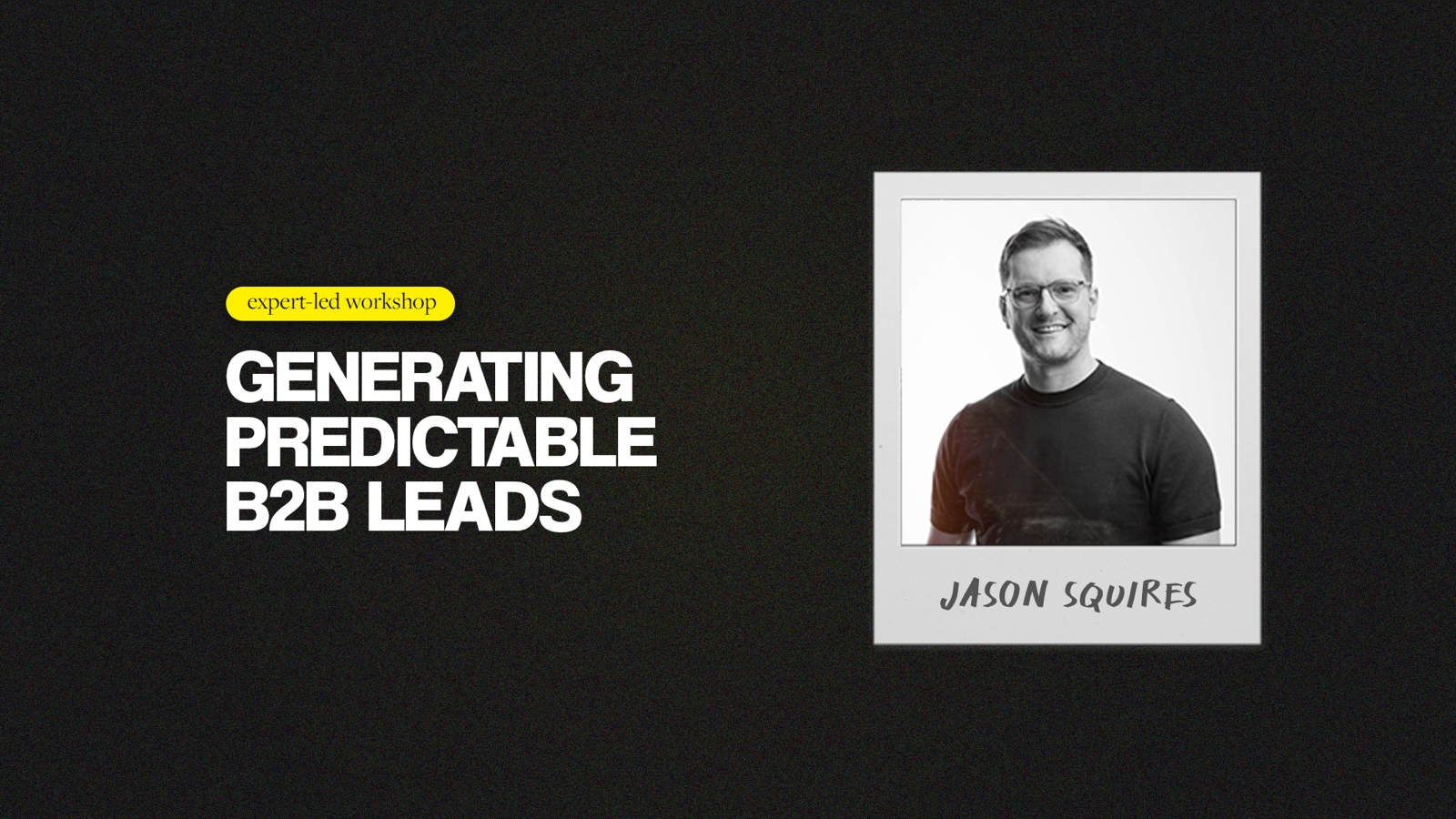
I've known Jason Squires since before Covid, so it was a proper treat to get him into The Content Club. Jason runs Project Scale. After 15 years on every platform going, LinkedIn is his main channel. His session: B2B enquiries you can predict, without chasing prospects all day or waiting on referrals.
Fix the foundations before the volume
When the pipeline is dry, most people reach for more traffic, connections and visibility. Jason disagrees: say the wrong thing to the wrong people and more outreach won't help. Predictable enquiries come from three things:
- the right audience
- a compelling offer
- a repeatable way of starting conversations with those people
Add up your LinkedIn connections and email contacts, then multiply by what one client is worth. That's the opportunity already in front of you. Jason calls it the dormant asset paradox: you have the expertise, network and results, yet still swing between feast and famine.
Narrow everything to one
Jason credits his "five ones" with taking him from £15,000 to £20,000 a month to around £150,000:
- One ideal client. Manufacturers, startups and charities are three different buyers. Chase one rabbit.
- One specific thing you solve or achieve for them.
- One service.
- One marketing channel. Double down on what has already worked.
- One sales process. You lead the buyer to the next step, instead of being dragged round extra calls, demos and "come back next quarter".
Instead of a dozen things to maintain, you have five.
Build a Blue Ocean Offer
Most markets look like a shelf of identical Buzz Lightyears. Jason's way out is to become a category of one: upgrade your ideal client profile, then build a Blue Ocean Offer.
Get past demographics. Find their one main problem, the "bruised rib" you keep poking. Check they can pay, and that they have what you need to deliver the result. For Jason, that's an established business that can already close work and has at least 200 LinkedIn connections.
The offer has four parts. The first two are essential:
- The problem. For Jason, it's the feast or famine rollercoaster, or relying on referrals.
- The outcome, the opposite of the problem, ideally with a number. His is filling your pipeline with a simple two-week campaign.
- The time frame to results. Shorter is better, but don't over-promise.
- Risk reversal, such as a guarantee or extra help to implement.
To find the problem, record your next few sales calls, put them into AI and look for the themes. Use your buyers' own words. Plenty of people offer LinkedIn training. Jason offers a full pipeline in two weeks.
Start with your Acres of Diamonds
In Russell Conwell's book Acres of Diamonds, a farmer searches for diamonds for years, then finds one in the stream on his own land. Your diamonds are your current connections, contacts and old leads.
Jason doesn't pitch them. He invites them. The first message says you're looking for a number of people like them who want a specific outcome in a set time, and asks if that's of interest. Reword the rest in your own voice, but keep that one sentence.
Start with low volume, send on a Tuesday at 10am, filter to people who've posted in the last 30 days, and do it by hand before you automate.
The campaign runs for two weeks, with posts, DMs and emails, and you can repeat it every eight to 12 weeks. One of his clients closed £36,000 over four weeks this way.
Then a lead magnet and Ask 48
Once you've worked through your network, go after new people with an outcome-based lead magnet: a 45 to 60 minute webinar, or a 10 to 15 minute video. The title is the outcome. Say who it's for and who it isn't, name the bruised rib, explain your process openly (most people won't do it themselves) and end with a call to learn more.
Ask 48 gets it seen:
- Connect with people who fit your ideal client, up to 200 a week with Sales Navigator.
- Wait 48 hours. No pitch slapping.
- Send a short note offering the video, and send a link if they want it.
Jason expects 30 to 40% of connection requests to be accepted, and 5 to 10% to ask for the lead magnet. When he hosted a video version in a LinkedIn article, it brought in around 50 leads a week, and he closed 20 to 30% of them.
Takeaways
- Fix audience and offer before adding volume.
- Cut to one of everything.
- Sell the outcome, with a number and a time frame.
- Invite your network first, then run Ask 48.
Want Jack’s eyes on your videos?
Inside The Content Club you get feedback on your videos every week, from Jack and business owners at your stage, and a clear system for turning views into enquiries.
Read the full transcript
Hello everybody in The Content Club, hope you're doing well, hope you're having a great week. I have got a very, very, very special guest today. I actually can't believe we've got him in the community. I have known Jason for a very, very, very long time, and it's only up until now we're actually collaborating on something together, which is really exciting, and I'm really proud to bring this to you guys today. So it's gonna be quite a hands-on session, we've got a lot to run through, and I'll let Jason kind of do the spiel in terms of who he is and what he does.
But he basically runs a company called Project Scale, and in the last couple of years he's done around seven million pounds worth of revenue from the content that he's created and run as ads, etc. And essentially we're going to be running through how you can do this yourself, okay? From creating organic content and, maybe if you're in the position where you can put a bit of money in towards actually pushing that out and running ads behind it, how do we kind of do that as well. So we're gonna be typing through a couple different things, systems, frameworks, all the rest. But get involved, write stuff down, pen to paper, as we always do. Any questions along the way, I'll be here to help, and I'll basically let Jason take it from here. So take it away, Jason.
Okay, thank you, Jack. That's a very kind introduction as well. Yeah, we have known each other quite some time now, haven't we? We have, yeah. It's going, it's going back a bit, yeah. Back before Covid, wasn't it, when we first, uh, we first, uh, kind of started chatting.
Okay, cool. So the systems for predictable B2B inquiries. It's one of the fundamentals which most people get stuck on, regardless of what size business they are, if they're starting, if they're growing or if they're scaling. It's always a concern, and the answer to most business problems is to make more money, to get more clients through the door. Sales cures all, and I'm sure you've kind of heard that before from a number of people, not just, not just me.
So from the top then, we're going to go tactical and practical today as much as possible. So I'm going to try and kind of cover off both, both sides, so kind of high level and then, and then eye level. So predictable B2B inquiries comes from having three things. We really want to boil it down to the important stuff. Firstly is to have the right audience, so you're only speaking to the right people. We don't want to dilute our marketing by including people who shouldn't really be there, because it's just a pointless, a pointless endeavor otherwise.
So firstly, the right audience. Secondly, we have to have something that they want to buy. We need to understand what they want, package our thing around that thing that they want and offer it to them. So we need to have the right audience and we need to have a compelling offer. And thirdly, from a systems point of view, we need to have a repeatable way of starting conversations with those people around the thing they want to sell, the thing that you sell.
So yeah, blindingly obvious and straightforward, and as you'll find, I'm going to go into the numbers that I've kind of pulled from my own, my own marketing and within my own business. But the majority of what we're going to be talking here is all about the foundations. If you don't have the right foundations in place, you typically aren't going to do much whatsoever. You can throw as much mud at the wall, do as much outreach, send as many emails, send us and run as many ads as possible, but if you're saying the wrong thing to the wrong people, you're just not going to get any results. So it always comes back down to, every single time, the foundations.
So the right audience, a compelling offer and a repeatable way of starting conversations, rather than a lot of busy work. So rather than constantly chasing new prospects who may or may not be interested, rather than hoping for referrals, which are inconsistent at best, even though they're great when they come, you can't rely on them when you're having a quiet period. And without having to create content every day. Now, I know that's going to contradict Jack's thing, so what I would say is take what I'm saying here today and use that in addition to everything else that Jack is, uh, helps you with within his program. Uh, so from my perspective, content is the supporting act to the stuff that works for me, so take a bit of both and then you can't go, you can't go far wrong.
So firstly then, who am I? Why should you listen to me? Why, what credibility do I have to kind of talk on this topic? So I keep this section short, but I feel it's important for context. So I'm 15 years in the trenches. I've seen every shiny object, I've tried everything on every platform going, right back from MySpace to Facebook to Instagram, and LinkedIn is really my thing now. Um, even with using LinkedIn, there's several ways of using it in order to get new clients, so I have my little niche within LinkedIn, which is a broader marketing program, a broader marketing channel in order to close new clients.
Over those 15 years I've built an audience of over 200,000 prospects: 81,000 on Instagram, 45,000 on Facebook, uh, 39,000 on X, which was Twitter back in the day, and 45,000, I think it's probably close to 50,000 now, over on LinkedIn. And that's my main channel. All the other stuff is just kind of vanity numbers, doesn't really add a great deal, if I'm being completely honest with you. It's all about LinkedIn. Now, you may have that experience, you may have experience of doing well on other platforms, which is perfectly fine, but today we're going to be focused mainly on, on LinkedIn.
And over those years I've been fortunate enough to attract 38,000 paying clients, both with low ticket offers, medium ticket and high ticket. My high ticket offer, we've probably closed close to 4,000 clients over the last four or five years, and that's really now my main focus, um, in my own coaching program. Um, again, for credibility, this is not tooting my own horn, this is just to kind of show you that this stuff actually works when it's kind of committed to. My own revenue is 1.4 million pounds per year, and we forecast to do 3 million within this, uh, this financial 12 months. Uh, so yes, make it exciting stuff. We're still, we're still growing, the game's not done just yet.
Um, and by way of who I've worked with, again from a credibility point of view, some names that you may have seen kind of floating around LinkedIn over, over the years. And more recently, Matt Lackiev, who's got well over 100,000 followers now, doing absolutely incredible in his little space, which I'm quite grateful that I've been part of his journey. Um, as well as Matt Barker, we've got 188,000 followers, Ryan Musselman, based over in the US, who's got 73,000, and Dan Sherrod Smith, who's at 65,000. Now, all of these are now absolute legends in the, in their own right. I can't take credit for their entire business success, but I was lucky enough to work with these guys when they were on the up and, uh, yeah, had some contribution to where they, where they currently are.
And what I've worked with them on is on their growth, not on their content. So it is wider than LinkedIn. We're talking ICP, we're talking positioning, we're talking offer, and then the fuel on the fire is content, is ads, or the systems that you can layer on on top of it. And then from a personal point of view, I live up in Newcastle in the UK, north of the UK, with my young family, Harry, who's eight, and Lily, who's five. Um, and Christmas just gone, we had a very special trip over to Lapland in the, in Finland, which was fantastic. Um, it's one of those trips that you do once in a lifetime, and I'm very proud and grateful that we were able to kind of do that, which is as a result of the work and the strategy that we're going to be coming on to today.
So business is hard. I've seen Jack post a few things on LinkedIn regarding this recently, and even if you're starting out, you're doing well or you're wanting to scale, business is hard work. So what I like to do is to set myself a lofty goal to keep me going, keep the fires burning. One of my goals was to take my children to Lapland, and my next goal is to have a box at, uh, Dan, love that, um, is to have a box at, uh, St James' Park for Newcastle United. That obviously doesn't come cheap, and I've also since realized there's a seven-year waiting list, so I don't know if that's going to happen anytime soon. But if they do build a new stadium, I'm hoping there's more kind of capacity to get more people in, more boxes, and I'm hopefully going to be on the, on the waiting list for that.
So before we go any further, what I'd like to do, everyone in the chat, if you wouldn't mind: what's your big lofty goal? What's the thing that you want to achieve, you want to do, you want to kind of tick off your, your bucket list, which gives you that motivation and that urge to knuckle down, close some clients, grow your business and live the life that you want to live? So let everyone do that for the next five or ten seconds. I think again there's a bit of a delay coming through with the chat, so I'll pause. But Jack, while we're here, what's yours, if you have one?
Okay, yeah, I want to pay my mortgage off by the time I'm 40, so 10 years, I want to pay it off completely. Um, on, on route too, which is good. So, um, so yeah. Yeah, good stuff. Uh, live in different country, Jules. Which one? Where do you want to go? Or is it any, just get out of the UK, if you're in the UK, I'm assuming you are. To have time freedom, so the business works for us instead of us working for the business. Oh, absolutely, Elizabeth.
Uh, I found that systems is the, is the path to that sort of freedom. I don't think you can ever completely unlink yourself with the business, because it's always going to be your baby, but it can certainly get easier when systems are leveraged. In the UK, have families elsewhere, it needs sunshine. Yeah, me and you both. Doom and gloom over, over here, isn't it, when the weather kind of turns. It's, uh, it's not, it's not fun.
Uh, yeah, so have a big lofty goal, whatever that is for you. Everyone's going to be slightly different, and it's all one and good reaching for a revenue level, which again is, you know, the fun tickets. Money just gives you fun tickets to do the things that you actually want, be it freedom or experiences or give your family the life they want. But we need to have that kind of, like, big lofty goal to aim for, to keep us, to keep us going when things get, things get tough.
Cool. All right then, chaps. So the systems for predictable B2B inquiries. We've got best part of an hour, we are 11 minutes in, so I'm clearly not going to be able to cover everything under the sun in this, uh, in this time frame that we have together. But I give you as much as I can, the biggest moving parts, to make the biggest impact, and then you can kind of go away and implement, uh, all of this into your business as much, as much as you can.
So we firstly need to see the problem for what the problem actually is. Not suggesting that you guys have this problem, but you may experience this regularly, frequently, infrequently, but you will at some point in your, in your business, your business experience. And that is the pipeline is pretty dry, there's no one to talk to, no one's, um, no one's replying to our marketing, no one seems to be listening, it's all looking a bit bleak, we need to get something moving.
So when speaking with hundreds of different business owners now on this one topic, this is the reason people kind of come to me when they're in this situation. They think the answer is that we need more traffic, is that we need to have more connections on LinkedIn, it's the thing that we need more visibility, it's the thing that we just need to do more volume. Whereas that isn't the case whatsoever. You can't keep throwing mud at the wall and hoping something sticks. We need to kind of view it slightly differently. We need to go back to, as I mentioned earlier, the foundations.
So the underlying conclusion of all of this: instead of just trying to throw more mud at the wall, we need to have an understanding that the market just isn't resonating with what you're saying to it. So you either have one or both of these things: either a poor offer that could be strengthened, and you have no systems to keep that engine burning when you are either working actively on your marketing or you're working actively with clients. What also typically happens, which again you may be, you may experience, is that when you are working with clients, your marketing drops off. When you're working on your marketing, your delivery for clients kind of drops off.
And what we want to have is the same level of activity on both of those areas simultaneously, and that, as within everything in life, comes down to the systems that run. I think there's a quote or a saying, which is, uh, the success of your business falls down to the level of your systems in play, or something. I may have kind of, uh, butchered that one-liner, but, uh, the underlying systems are essentially how successful your business is going to run. So improve the systems, improve your business, and we all get what we want.
So, a little bit of an activity I like to do. It's not too much, uh, mental, there's not too many mental gymnastics needed, but just to paint a picture, to show you the opportunity you have in front of you. I would like you to stick in the chat two numbers combined. Firstly, how many LinkedIn connections you have, plus how many CRM contacts, old leads or email contacts that you have floating around on a newsletter or in your database or whatever. It doesn't have to be an exact number, it could be 500, a thousand, two hundred, five thousand, whatever. Just kind of stick a number in the chat, just so we can see where we're at. Any number is a good number. More doesn't equal better, but I just want to highlight what's available to us.
Jack's killing it, 40,000 plus 200. What else do we have? I'll be patient, or people, yeah, there is a, there's always a slight delay on Zoom. 1,800, perfect, Dan, love that. Fair enough. 13, 130, 250, lovely, lovely stuff, that's a great base there, Jules. Okay, excellent. So then, what way to do, if you don't share, that's fair enough, and people are going to be seeing this on the recording anyway. Uh, 750 connections, about 400 leads, even better, 1,100. If you've got a kind of an even split between them, um, fantastic, yeah, you've got two, two bites of the cherry there.
What I now like to do is to get an idea, or rough idea, because people have got different packages and different service offerings, what one client is worth, revenue-wise. Could be lifetime value, it could be the first thing that you do with them. Just get, stick a number down wherever you're making notes. Could be 2,000, 5,000, 10,000, could be 1,500, could be 500, whatever. Stick your number down, and then in the chat, please, guys, might get it quickly after with your calculator, trying to kind of do this on the spot, unless you're good at maths: multiply the two. So for Jules, it'll be 1,300 plus 250, so it would be 1,550. 1,550 times how much a client's worth, and then stick that number in the chat. Or if not, stick it in the chat, if you don't want to share, which is fair enough, jot it down on a piece of paper and draw a big circle around it, because that number is the opportunity sitting in front of you, staring at you.
2.5 mil, love that, Jack. You've got runway till your eyes stop watering. It's, uh, it's fantastic. So we're not going to be closing that amount of business, obviously, but I want you to see your current network as that opportunity, and we want to be using that as our pipeline to close as much of it as possible. Now, a lot of people see their current network and they dismiss it. They think it's dormant, there's nothing going on with it, nothing's happening with it, so they just move it, move it to one side, and they're constantly kind of chasing new connections, new relationships, trying to meet new people. Whereas they've got all these people right in front of them who already know them to some degree, which is your lowest hanging fruit.
5.4 mil, boom, I love that, Dan. And if you get them on my new offer, 1,500, kuperhanum, 2.2 million, love that. So if we're looking at closing 10% of that, or 5% of that, we're talking significant difference compared to where you're sitting right now. So I just want to kind of highlight that opportunity. Instead of trying to chase new shiny things over here, you've already got everything you already need right in, right in front of you.
So it comes down to what I refer to as a dormant asset paradox. You have the assets already, you have everything you already need. Breaking that down: you have high expertise, you run a business, you're successful in delivering your service, you have a large network, and you've already delivered the thing to your clients to get them a result. You have everything you currently need. Although at the same time, and this is where the paradox kind of comes in, you have all these good stuff, but similarly you may or may not, I'm not calling anyone out here, you may have inconsistent revenue, you may have an empty pipeline, nothing seems to be happening right now, and you go through that feast or famine cycle. You have a good month and a bad month and a good month and a bad month, and nothing seems to, seems to change.
Now, business will always be seasonal, there will always be a cycle, but we want to try and mitigate this as much as possible by taking advantage of what we actually have, rather than trying to take the newest, latest, greatest strategy that's going to turn your business from nothing, nothing to something in 30 days. We want to use what we've currently, currently got. So yeah, hoping I'm kind of hammering that point home now. Again, from a foundational perspective, I told you this is all going to be foundations today and then fuel on the fire of the systems, we want to create a client pathway.
So another common issue I see when I speak with business owners daily is that every time they get a new client, they go on a completely different path with them. So one needs a call, then they need a second call, then they need a third call, then one might need a face-to-face, another one might just need a Zoom call or two, another one might just buy straight away without even having a conversation with you at all. You're essentially pulled around on these different journeys with every single client before they pay you money. From a systems perspective, that is the most horrendous way to run a business whatsoever.
So we need to systemize it. We need a simple flow of what one person does when they get in touch, what you put in front of them, the next step, and then you look to close. So instead of dragging them around, sorry, instead of them dragging you around, um, in their buying process, they like to buy in a certain way, so they just need an extra call and they just need to sense-check this and they just need to wait for whatever, we essentially lead them by the hand and tell them what to do next before they suggest the next step. Then you have a system and a routine that you can just put more people into your sausage factory, which is essentially what it is, and you have more reliability and more of a forecast on where everybody is in the, in the pipeline, and how many deals you've got on the line, and how many is closed, and how well it's all performing. And then you can look to improve each of these sections to get the flow flowing better.
So I'm going to start with this, which I have done here, creating a client pathway. I'm going to go through the bulk of today's session and I'm going to end with it, to show you what the steps may typically look like. Yours may be different, but just to give you an idea of what that, but what that may look like in the real world. So, um, how are we doing so far? Are we liking what we're hearing? Are you picking up what I'm putting down, or am I talking gobbledygook to everyone? Just a sense check before we crack on with the, with the meat.
All good, thank you, Jules, appreciate that. Doing good. A little bit, doing good, a little bit of validation, I think that's what I'm kind of looking for just there. All good, appreciate that. Okay, so let's, let's jump in then, shall we? So the plan itself. Thank you, Elizabeth, appreciate that. So I'm a fan of triangles. You might see the, good, sounds good, Jason, thank you, Dan, I appreciate that. Um, all good, the pat on the head, that's what I'm looking for. Um, so triangles. I'm a fan of triangles. I feel it's easy to explain things when you've got a bit of a visual framework or demonstration in front of you, so triangles are my thing.
So what we want, we're going to stick in the middle, which are new clients. Pipeline's good, but new clients are better. You can't have one without the other, granted, but at the end of the day, it's clients that we're after. So three things that we're going to cover today, each as important as the previous, and you can't have one without the other. They are building blocks that kind of build on top of each other.
The first of those is digging into and creating and establishing yourself as a category of one. There is so much noise out there on the internet, in your market and generally these days, that it's hard to get and keep attention. The first rule with anything in business is to get people's attention. We want the right people's attention, but we still need that attention. They're not just distracted by other competitors in your industry, they're distracted by life and family and social media and dopamine and Instagram and all this other stuff. So we need to make a concerted effort to stand out to the right people and put the right thing in front of them.
So we're going to start with this. Every issue I see every business have with lead generation is because that's not configured strongly enough. Get that right, everything else flows. The rest of it is the easy stuff. This is the bit which needs to be, needs to be fixed, um, for the most part at least. So we're then going to look at Acres of Diamonds, what you have to play with right now, that dormant asset paradox that I reference: your current connections, your emails, any old leads in your CRM that you haven't contacted for a period of time. They are your current opportunity. That will be the closest to new clients that you have available, available to you right now. So we're going to dig into that, what that looks like and what you can do to start getting your pipeline nice and full from your current assets.
We are then going to move on to, so this is kind of like what you've got to play with right now, we're now then going to move on to, sorry, new people. So you've exhausted your current network, what can we then do on a medium to a long-term basis to keep that flow flowing? So OBLM, that stands for outcome-based lead magnet, a key asset that you can use over and over and over again to draw the right people to you, qualify them and set them up for the next, which is either a sales call or some form of intent-based conversation, which moves them closer to giving you money. And then to get people onto your, or through and delivered to your outcome-based lead magnet, we want to run a system called Ask 48. Very simple in nature, not rocket science whatsoever. We essentially just want to offer the outcome-based lead magnet to as many relevant people as possible, to get them to consume it, to get them into your client pathway in order to close.
So we're essentially looking for hand raises, people to raise the hand saying, yeah, that sounds of interest, can I have more information, or send it over, or whatever the, whatever the one-liner is. So that's what we're going to look at in the next 37 and a bit minutes. If we go slightly over, I'll try and keep it, try and keep it tight.
So, big concept, which isn't just to do with lead generation, it's to do with running your business from top to bottom. And this is what took me, um, literally the framework that took me from averaging 15 to 20,000 pounds per month to now kind of touching 150,000 pounds per month. We kind of, it wobbles every month, 130, 160, 145, but it was the next big step that allowed me to kind of step up, because I was just getting in my own way. The biggest bottleneck for most businesses is the business owner. Most businesses are perfectly fine, it's the one running it which kind of slows everything down. When you realize that and do things to kind of mitigate that, uh, the next level of growth is, is typically unlocked.
So it's all about the five ones. Keep things lean, simple, efficient, focused, in order for you to grow to whatever level you want to grow to. The world is literally the limit, and if you want to be completely dominant in your, in your industry and be the go-to person or company within your entire industry, this is what's going to take you there. So the five ones are as follows, a pyramid. First of those is one ideal client. Now, again, clients come to me and they have three different personas they're targeting: manufacturing businesses and startups and charities. Now, those are three very different ICPs. They have different wants, needs, desires, and your marketing is just going to be diluted if you're trying to capture all of those three at the same time.
So what we want to do is chase one rabbit. If you try and chase two rabbits, they're both going to run off and you're going to catch, you're going to catch neither of them. So we need to dial in our ICP and focus everything on our ICP. Talk to the market, no, sorry, I rephrase that. Don't talk to the market, talk to the person, that individual avatar, which will then, um, allow you to stand out to them, and they'll lean in to see what you've got to say. So the first, the pyramid, one ideal client.
Secondly is to solve or achieve one specific thing for the ideal client. So don't offer them everything you can possibly do. That's all well and good if you've got many strings to your bow, but again, that just dilutes your messaging. They don't really know what you actually help with, because you're talking about four, four different things simultaneously. So we want to be solving one thing, or achieving one specific thing, for that one specific person. You get the attention, those who have that issue with that thing know you're the person to, to help solve it.
And in a perfect world, we want to be doing that by one service. So don't have three things that you're trying to deliver simultaneously, because then you're just going to be slowed down in the weeds of service delivery. So where possible, and this is where it takes a bit of time and a bit of kind of mental gymnastics for people to unlink themselves from, but we offer three different things, why would we not offer three different things? If you can only offer one thing, you only have to provide and deliver one thing, and everything becomes easier from start to finish. There's only so much you need to, there's only so many plates you can have spinning, so if you can take one plate down, there's no, there's no issue, um, there's no negative to doing so.
And then from a marketing perspective, we want to commit to one marketing channel or one marketing type. So if video is your thing, with Jack, kind of commit to video. What we don't want to be doing, which is another common thing, and a, um, something I experienced when I was growing my business through the trenches over the years, is that I was doing SEO and in-person networking events and trying to land speaking gigs and doing pay-per-click and then trying a little bit of Google and then doing some content over here and trying to have a go at Facebook ads. You would just spread too thinly in all areas. So focus on what's working and double down on the thing that's working. You're only going to get more. You don't have to do the rest, just do the thing that's worked for you before and do more of it to get more of the same.
It's blindingly obvious advice, but I think as human beings we just try to do more, as much as we can, in as many areas as possible, and we tell ourselves that it's progress because we feel busy. We don't want to feel busy, we want to see, we want to be productive. So not busy, productive. And then finally, one sales process. So that comes down to the client pathway. So instead of, again, having a call and a second call, then a face-to-face meeting and then a trial and then a demo and then this and then that and then the other, you have a certain process of: this is the next step, are you okay to move on to it? If they're interested, they say, yeah, that's fine. But if you let them lead, you're going to be led around the houses to a "come back to this next quarter, we'll revisit again", which is frustrating to everybody.
So guide them through one sales process, and everything at every stage becomes easier the further you get up the pyramid. So instead of having, say, three ideal clients, and you're trying to do three different things for them, you've got two different services that you could offer, and you're trying to market across four different channels, and you've got an unlimited amount of, of sales processes depending on what they want to do. Instead, instead of having three, six, eight, twelve, plus the unlimited sales processes, you've got one client, one thing that you're doing for them, through one service, and you're marketing on one channel, and you're selling them for one certain particular way. Gives you only five things to maintain. So instead of having 12 considerations, you've only got five. It strips away everything that doesn't need to be done, and you've got a lean, clear, linear path to getting what you want to get, whichever you put down as your goal at the start of the session.
So for me, initially it was 100k a month. Did that, just committed to it, avoided everything else, you got to 100k a month, and then it was another, another goal beyond there. What you thought, someone want different tiers of one service? All well and good when they're on the inside, that's fine. So the front end of your marketing needs to be one thing for one person, and ideally one service, and then when they've done that one service, then you can then upsell them or cross-sell them or do whatever you need to do. Um, but from your marketing perspective, we're just focused on one, one of this, one of that, one of the next thing, one of the other. And then when they're inside and they're a paying customer, you can then kind of spread them out into different areas, if you have other services that you can kind of bolt on.
Um, now, when I present this to people for the first time, it often just comes, or kind of, um, manifests a little bit of internal friction, which is fair enough. This is the way we've always done it, we've done it this way for five years, but I will change it now. So change is uncomfortable, but again, you can lead a horse to water, um, and then everyone can make their own minds up if they, uh, if they choose to go efficient or not. So in the chat, please, guys, um, is any one of these things difficult for you right now? You're not sure how to do it? And if you wouldn't mind giving me a bit of context, I can give you some pointers on how you may want to, uh, you may want to kind of challenge it and work on it and improve it.
What do the services, Jack, that you offer, the different tiers, did you say? So I was, yeah, I was interested in that because, um, sorry to steal the thunder, guys, I thought I'll steal Jason's time for a sec. I obviously run The Content Club. […] I tend to find either some people upsell themselves to that, because they join and they say, actually, I need a bit more support, or from the get-go when they can join, they have a choice between: do I want to do this myself within the community, or do I want Jack's implementation support, consulting, advice on top of being part of the… There are two different types of prices as well. So I was just interested in that. Uh, they're the same service, but one just comes with a bit more implementation from me and a bit more guidance. That was, yeah, that was, yeah, I was interested.
Oh yeah, that's fair enough. Yeah, I think what I would do, if I was on a, in my kind of consulting head and I was giving advice on that, I would pick either to kind of lead with a starter package or lead with the, with the VIP. I wouldn't try and pitch both simultaneously, because then your marketing is only ever going to be targeting at one of those at any one time. So if you want to kind of split it 50/50, you've only got 50% of your marketing efforts on one and 50 on another, where you want 100 on one of them. Um, it sounds like, if there's an actual kind of progression from one to the other, start with the starter and then upsell them when they're on the, when they're on the inside. Um, it's always easier to go for a lower tier, smaller thing to buy first, because the sticker shock isn't quite as harsh, and then you can upsell them when they've got the, when they've got the value. But I know this is not a session between me and you, Jack, right now, so I don't want to kind of dig too deep into, into what you've got, you've got going on.
Uh, Jules: actually halfway through this on my own, got the one service, niche, marketing, sales. Perfect, love that. Yeah, validation there, I suppose then, Jules. Um, I think where it's difficult is when people have been in business for 10 years and it's the way they've always done it, and it's really hard to kind of unlink from, um, the norm, I suppose. Uh, but when they do, and this is what I did, that's probably 10 years into my own journey before I actually kind of figured this out myself through trial and error, and it's hard to drop things when you're just in the, in the zone of doing it. So even if you're doing content on Twitter, for instance, or X, and that's just what you've always done, but you're not getting anything out of it, you still feel compelled to keep doing it, even though it's not actually giving you what you want to get. So try and be mindful of all of that activity that you are doing that's not giving you anything, and get rid of it, and then focus on the stuff that has moved the needle and do more of it.
Uh, Dan: crystallizes what Jack's been trying to get to do, I need to be clear at the bottom of the pyramid. Okay, cool, yeah, good stuff. Uh, give myself a pat on the back. Yeah, oh, excellent, good stuff, Julie. It's hard. The longer you're in business, the harder it is to kind of be, to make these kind of changes. It just feels unnatural to kind of, uh, to change course when it's like a lifetime of behavior almost, if you're, if you're 16 years in. So that's, uh, that's great.
Cool. All right, the chaps, looking good. So let's move on then. Uh, more foundational stuff, I'm sorry, I told you this is all going to be… Is it subject, subject matter experts? When I do client two spread, still wrestling with that. Subject matter expert is, is one of, is one of the things. So you can be a subject matter expert when you're solving and demonstrating, achieving one specific thing, but you want to be targeting one specific person. Um, to be great at video, but who do you want to be great at video for? So that's the, the two kind of niches that you want to kind of focus, focus on: who you sell to and the thing that you're selling. You can go broad in either, which isn't great, but if you go broad in both, that's even worse, and you'll find yourself spinning your wheels for a very long time.
Um, cool. All right then, chaps, moving on. So, creating category of one. Just to, um, call a fish a fish, this is the current state of every market at the moment. We all sell the same stuff. It's just a load of Buzz Lightyears on a shelf, trying to pitch the same people the same thing, and every individual Buzz, which is an individual business, every individual Buzz is saying to themselves, why isn't anyone listening? Why isn't anyone kind of latching onto our thing? Because our thing's really good. Everyone looks and sounds the same, but no one's got the awareness that everyone looks and sounds the same.
Until you have that epiphany, nothing's going to change. When you do have that epiphany, you can then intentionally be as different as possible to stand out, get the attention and get, um, get focus on you and away from your market. So there's two main things of how to achieve that. Again, it goes back to the very first slide that I, that I had in this session. It's to upgrade your ICP, so firstly who you sell to, and then secondly having a Blue Ocean Offer, which is my quirky term for having a compelling offer. I'm going to come on to that in a second.
So firstly, to understand who you're, who you're selling to. Dial down on that avatar, on that individual, and talk to nobody else other than that one person. So if you're looking at manufacturers and startups and charities, they're three very different individual ICPs, and we only want to be working with the best version of your ICP. So the ones that have the means to pay is the main thing. You don't want to be targeting people or working with people who don't have the means to pay, because it's just a slog. We've all been there, when invoices aren't paid because they can't afford to pay them, and it's just a painful way to do business. So we want to be looking at the top of the pyramid by way of the best clients, maybe not necessarily whale clients, but just those who have, um, who value what you do and have the ability to pay for it.
So how to dig into this. The basics of the demographics. So, uh, small businesses based in London who have three members of staff and work in marketing, they're kind of like your demographic. So everyone should have these dialed in already. If not, go back to that drawing board and get the absolute foundations dialed in and have a description of who they are: job title, description and industry, of the, the three, the three basics. Then we want to understand what problem it is that they have that you can solve. So instead of you shouting about the thing that you do and hoping someone kind of latches onto that, we need to be talking about the problem that they have. Not problems plural, looking for one, one main problem.
The main problem, I call this a bruised rib. We want to be poking the bruised rib. Now, there's many reasons why we want to be doing this. The main one is that the more specific you are, the more relevant you are; the more relevant you are, the more attention you get; the more attention you get, the more people that go into your client pathway, and the more clients that you inevitably will close. The other main benefit, to be fair, they're all main benefits, to be fair, why to focus on one problem is that if you can articulate the problem they have better than they can, so you can read their mind, because they'll be thinking these things but they won't be saying them out loud, and if you can put that in a sentence and put it in front of them, they will think you also have the solution to that problem. They'll think you're one step ahead, you understand them, what you got for me, and they'll lean in to see what you've got to say.
So firstly, down in the demographics. Then how, do they have a problem that you can solve? Do they have the means to pay for it? Should be an obvious one. And what's not so obvious is: do they have what you need them to have in order for you to deliver your service? Now, I give an example of this with my business, in my program, which is lead generation, this dialed down into kind of the most nuanced detail you can possibly imagine. And I need them to be an established business. I need them to be able to close clients when they can get them, so when they get inquiries, they can close them. So if they can't do that, they've got a sales problem rather than a lead generation problem. And thirdly, do they have at least 200 LinkedIn connections?
If they have 200 LinkedIn connections, they can run my strategy, and almost I can guarantee a result. Do what I say, they're going to do, they're going to get a result. But if they don't have 200 LinkedIn connections, they don't have what I need them to have, then they're not qualified. I either, I don't have a downsell at the moment, but I would typically either downsell them, would pass them, or I would pass them over to somebody else who could help them better based on their current situation. So it's more of a qualification piece, but you don't want to be talking to anyone on the phone if they don't have what you need them to have.
Say if you're a fleet management service and you have this app for companies who had a fleet of at least 15 lorries, a random example. If they've only got five lorries, there's no point in them having a conversation with you, because it's just not going to work. They don't have what you need them to have. So think about what that thing is. It could be a certain number of website visitors, or a certain number of, uh, staff members, or a certain number of offices around the country, or whatever it is. There's going to be something that you need them to have for you to deliver the result, so get clear on what that is.
So after upgrading your ICP, you're only targeting the people who can pay you money, have the problem you, have the problem you solve, and also have, uh, the means to pay for it, and then the things you need them to have to qualify themselves. We need to put something in front of them that looks attractive, and I call this a Blue Ocean Offer. Red, red ocean is oversaturated, everyone looks the same, no one's different. Whereas the blue ocean is, you're standing out amongst everybody else, you're a beacon of hope, a beacon of light, they are drawn to you rather than to everybody else. And this is the thing that's going to make you the money. This is great as a qualification piece, but this is what's going to move the needle by way of revenue generated. The stronger your offer, the easier the sale.
Because prospects are innately selfish. We know this, but as business owners, we are also selfish. We talk about ourselves. We want to flip that around and only talk about them. In all of my marketing that I do, I very rarely talk about the thing that I offer. I'm just talking about their problem, what they would like to achieve, and then in their life they then come to me, and then I present them what I've, what I've got to offer. So your prospects are innately selfish. Obviously they don't care about you, they don't care about your service, what you offer them. They only care about what you can do for them. Again, what's in it for me. So we're going to be thinking about and creating our offer around that.
So I think this is a Venn diagram. I don't even know what a Venn diagram is, to be fair, but I think it's an overlap in some shapes that overlap with each other, I'm not entirely sure. We have you over on one side and the thing that you offer. We have them over on the other side, thinking about themselves and worrying about their own problems, not caring about you whatsoever. But there is an overlap in the middle, and that overlap is the sweet spot that we need to dominate, and that is the outcome that you offer. So it's never about the service, never about the thing that you do. It's about the thing that they get. It's about what happens as a result of your service, is what they're buying, which is going to get them to purchase.
They don't really care about accounts or marketing or video production or website development. They care about making money and saving time. It could be both of those things, it could be one of those things, but we're selling the outcome, the thing that they actually want, which is the opposite of the problem that they have. So it's yin and yang: problem they have, outcome they want. Put both together in your marketing, you're off to the races. So I've got a bit of a freebie coming up for you with them in a moment, um, in regards to this as well, which I'll, uh, which I'll drop in a second.
Is everything making sense so far, though? Just a bit of a, a thumbs up, a pat on the head for Jason in the, uh, in the chat. Is everything making sense, or am I going off on tangents, which, uh, we were just, touch confusing? Perfect, thanks, Jules, love that. You know, I lost everyone else, I apologize. We're good, Jack comes up winner. Thank you, appreciate that. Thank you, Dan. An emoji, love emoji. Who doesn't love an emoji?
So your Blue Ocean Offer then. Four key components to it. You don't have to have all of these things, but have as many as you can. The first two you definitely need. The second two, now, if you can do it, if you can't, it's not the end of the world. So we're firstly thinking about who we sell to, the main person that we want to be getting the attention of and keeping the attention of. We want that bruised rib. Now, I focus my bruised rib, so I'm lead generation, the situation that people find themselves in before they come to me. So what do they need to be experiencing before I ever even enter the picture? That's what we want to be talking about.
Now, for me, it's two things. It's either the feast or famine rollercoaster, so I'm always talking about feast and famine, having a good period, bad period, good period, bad period, because then that draws them to me. And secondly, is a different, slight variation of that, is, um, relying on referrals. So when referrals dry up, what do you do? Everyone's like, oh, I don't know, because referrals have dried up and I don't know what to do. That's when I then step in with, uh, with what I can offer instead. So we want to be thinking about the main problem that they have, the most commercial problem that you can see, the biggest financial reward for them if they were to take you up on the offer that you have.
And a great way, if you're unsure of what that might be… We don't want to be guessing. You can guess, if you've got a good feel for it from your experience, but a great way to get that information is, over the next handful of your sales calls, record them, stick them into AI and ask them what problems they're saying. And after a few phone calls, you'll see the same things being referenced over and over again. What you then want to do, when you've got those themes, frame them, word them in their words. Use their own language against them. Now, it sounds immoral, but all we're doing is we're understanding our customer and using that information to improve our marketing.
So, Blue Ocean Offer: you to understand the one problem that they have the most, that you can hinge all of your marketing around. You then want to have the outcome. What's the opposite of that problem? So for me, instead of having feast or famine, have a consistent, reliable pipeline. Um, yeah, so problem is no leads, outcome is leads. Want to ideally have a number involved in any of this. Numbers get attention, attention gets more traction, and you get more people into your client pathway and you close more people. So include a number.
How I do this: my outcome is "fill your pipeline with a simple two-week campaign". So the number I use is two. It used to be 10 inquiries per week, but that got completely saturated after doing that for two or three years. The market, market started to drift, so I changed it to give them a pattern interrupt. I changed it from 10 inquiries per week to a pipeline full of inquiries within a two-week campaign, which is the length of time it takes to run and to get a result. So feast or famine to a full pipeline in, in two weeks.
Thirdly is time frame to results, which is kind of what I've just explained, that I've merged the two. So time frame to results: how long is it going to take to get the thing that they want to get? Um, if it's an indefinite period of time, people are going to delay. They need to know when they're going to get it, when they're going to get the thing, when, when they're going to achieve the result that they want to achieve, to get them out of the problem that they're currently in. If you can shorten that as much as possible, it's only going to make you more attractive. We don't want to over-promise, though. I think there's a risk here of kind of pushing that a little bit too far, and then from the delivery aspects, when they are working with you and they realize that they're not going to get it in the time frame that you've mentioned, you've kind of put yourself in a bit of hot bother, which we don't want to be doing. So be honest and genuine, but we want to give a time frame, and the shorter that time frame, the better. So however you can engineer that, it will, it won't hurt.
And then we have risk reversal. Make it easy to say yes. What can you remove for them? It's typically going to be either a time barrier or a financial barrier, to get them to give it a go, to try it, to work with you, to, um, to say yes. So it could be a money-back guarantee, it could be we'll work for you for free until it's achieved, or it could be we'll do it for you, or it could be we've got a next team, an extra team member that can help you implement X, Y and Z. It's going to be different for everybody based on, um, what you deliver and how you deliver it. We want to lower the barrier to get them to say yes. Make it easy for them to say yes and suppress go.
And if you can tick as many of these boxes as possible, the first two have got to be a dead, so you have to do those two, but if you can also work on these two, then your offer is going to be as strong as it can be, and you're going to close as many people when you're in a sales conversation with them. So we want to be talking about the outcome, not features or the benefits. People don't care about features. That comes way later down the, down the sales process. Benefits are very general, you're blending with the, with the crowd, and the outcome is the reason why they are purchasing and what they want. Now, most companies don't do this. It's blindingly obvious to me, and I can't fathom why more people don't do that, but that's the state of play, so it's easy for us to stand out when we nail that.
For example, there are so many LinkedIn trainers, coaches, consultants, marketing programs out there on the internet that it's, it's hard to even keep track of the latest one. So everyone is saying, would you like LinkedIn training, would you like LinkedIn training, would you like LinkedIn training? Whereas I, I'm saying something slightly different: would you like to fill your pipeline with a two-week campaign? It's the outcome they want. We're still all selling the same thing. I mean, I can't vouch for the, the quality of half of these LinkedIn programs, or even if they're going to deliver a result for people, but I'm focusing on the outcome they get, not the delivery of what the thing is. It's a big difference, and it will allow you to stand out when you're vying for the same attention from the same pool of people who are all looking for the thing that they want. You stand out.
So, half an example of this. After creating your Blue Ocean Offer, one of our members said, "It's the most engagement I've had from a lead gen activity in ages." It is an instantaneous response. So as soon as you change something, your marketing will improve overnight, and it's not an exaggeration. Try it, you'll see it, and, uh, you'll then become a believer, if you're not already. So that freebie that I mentioned, a bit of a play on words here, a bit of a quirky acronym, jasonsboob.com, which stands for… There's no untoward pictures on that website. BOOB, Blue Ocean Offer Builder dot com. So I'm being a little bit cheeky, I know what I'm doing here, but, uh, but yeah, jasonsboob.com. What it is, is a GPT built on ChatGPT, which will guide you through, which will guide you through all of this, each of these things. It'll ask you, ask you questions, you will put your input in, and it will help you shape it and firm it up. And at the end of the day, then, that little routine, it takes maybe about 20 minutes to do, you'll have a Blue Ocean Offer that you can then test with your market, market and see how, how it goes. Uh, so yeah, jasonsboob.com.
So on that, wow, we are cracking on with time here, I'm gonna have to kind of speed up a little bit. Um, any questions before we move on? All good for me, Jason. Yeah, sweet. Let's give the chat five seconds to catch up, just to make sure I'm not missing anybody. I think this always goes the same way as well. There's so much I want to talk about, thinking I'm keeping it nice and lean and efficient. We'd have to get you back, Jason. It looks that way, it doesn't, say, Jack, to be honest. We have to go for a round two. Yeah, all important stuff, though. Thanks, Dan, yeah, I love that. Good stuff. Uh, excellent. Oh, where's the chat going? Okay, cool.
Right, I don't want to go at the speed of light, but, um, I'll be more efficient with my descriptions from here. So, Acres of Diamonds then. We have put a big tick in that box: category of one, your ICP and a Blue Ocean Offer, and the reasons behind it, and what's focused on, mainly about problem and outcome. Um, then we have Acres of Diamonds. We want to be taking advantage of what we have to play with. So it's a concept that I took from this book, Acres of Diamonds, by Russell Conwell. It's a book that was written back in, I think it was like 1910 or something like that, so well over 100 years ago. Um, and, uh, when I, when it clicked for me, it's, um, it's delivered millions in revenue, uh, both for myself and for my own clients.
And this is just something to take advantage of every eight to 12 weeks. You can run this, um, once a quarter max, or every eight weeks if you want to be more efficient with it and squeeze more juice out of the lemon. And it's all about taking advantage of what you're currently standing on. Now, the story goes, there was a farmer on a farm in America somewhere, and he wants to go look for diamonds. So he was hunting all around the US, all around Canada, looking for diamonds, and he found none. After his 10-year journey, he came back home, making supper one evening, went down to a stream at the bottom of his field and found a diamond, a diamond in the stream, and realized he was sitting on an acre of diamonds. So without searching long and hard elsewhere, everything he had was right between, right beneath his, uh, his feet.
So, results when doing this. One of my clients, Gemma, closed 36,000 pounds over a four-week period, and Daniel closed 73,000 pounds of annual retainers, um, after his first campaign. It took him 30 days to close them, but that filled his pipeline, which he then was able to close 15 meetings and just shy of 74,000 closed, um, from the, uh, the responses that he got. So Quick Wins Accelerator is how I frame it, because it's essentially quick wins. You can do something, it doesn't take long to set up, doesn't take long to run, and it will get you going relatively quickly. Uh, so yeah, hence the name.
So take your current audience, your LinkedIn connections, your email contacts, and then we put a campaign in front of them. So we are not directly pitching, we are inviting them. There's a big difference, and the psychology in it allows the barrier to go down. Rather than them feeling that they're being sold to, you are asking them if they would like to be a part of something. So it's a conversation sequence, which in its essence is, uh, is an invitation, and we send that out via DM and via email. And then we have certain times and certain days that we send these messages out, which again is, uh, built on psychology, on timing, on the optimal time within people's working week. So when, when's best to kind of send a message and get a, get a response, and in order to stack all the odds in our favor and, um, yeah, get a result.
So now, I know we're definitely squeezed for time, so we haven't got time to go right into this nitty-gritty, but I wanted to give you the very first message that you would send. So you can take a screenshot of this, um, or I can send it over to Jack and then, uh, Jack can kind of put it into the group, or however you, uh, you would like to kind of distribute it. But this is the first message of that sequence, via DM and/or email, if you've got, uh, contacts in both pools. And in order to get people to say yes on the thing that you offer, we are only sending this to people, to your ideal client. So we can filter them based on Sales Navigator, or on LinkedIn Premium, if you've, uh, if you've got the other version of it. So we're only sending this to those who fit that description of, of who you sell to.
So: "Hi John, happy Tuesday. Just a quick one. I'm looking for X", so number of, "describe who they are, who want to get the thing that you offer", so it's not the service that you provide, it's the outcome of that service, "in the next", when are they going to get the thing. "Would that be of interest? Let me know, I want to send further details across. Thanks, name", your name. It's as simple as that. It's not rocket science, but this has generated millions in closed revenue over the, the last few years that I've been running this, both myself and for clients.
Now, start with low volume. You can send up to 200 DMs per day, so if you want to really go for this hell for leather, go for it. But what I would suggest doing is do it slow and steady. If you don't like the way I've worded this, put it in your voice, but don't take out the key bits of information: number, ICP, outcome, time frame. This is the main sentence. If you want to put it in your words, use your personality, do whatever you need to do, I'm going to change it to make it feel like you, that's perfectly fine, but don't change that one sentence, because that's the psychology. There's urgency, scarcity and relevance all rolled in to one sentence, and the results are surprisingly good. I'll, uh, play it down, but, um, but yeah, it's good.
So start with low volume. Optimal time is Tuesday, 10 o'clock, so send it at that time. Uh, filter to active users. So if you are using Sales Navigator, there's a little section you can filter people via, which I believe is, uh, LinkedIn activity, and it's posted within the last 30 days. If they post on LinkedIn regularly, you know they're using the, the platform often, and they're going to see the DM, and therefore there's a higher chance of them responding to it and replying, either if it's a yes, no or maybe, it's going to increase the chances of a response. Do it manually to begin with, to find your feet with it, then you can move on to automation. Automation, we use a tool called Octopus, like the animal with the tentacles, octopuscrm.io, I believe it is, and then that can send it out for you, one after the other, without you manually having to be there to press any buttons.
Um, the wider, broader campaign is over two weeks, as I've mentioned. So we have, um, organic content that goes out to support the campaign, we have DMs that go out, which is the, the first one was the previous one you saw, and then we have emails. If you have both an email and a DM list, you can kind of hit at the same time. There's a, an email sequence that goes out over that, over that two-week, two-week period just there. Um, you'll have the slides for this, so I'll let you kind of screenshot, make notes of what to go out and when. Um, ideally everything goes out at 10 o'clock, or as close to 10 o'clock as possible, on each of these days. Uh, highest response rate, from my experience over years of, years of doing this.
Um, all the results: uh, David generated 35 inquiries in six hours and closed, I think it was 50,000 pounds worth of new orders as a result, and Gareth now has more inquiries than he knows what to do with. Uh, James went from 50,000 to 350,000 pounds per month. When he was in a serious feast, sorry, a serious famine period, he did this and it basically saved his bacon. Um, and then Roy has closed 400,000 pounds in new business so far. Um, James is, works in construction, Roy is a business coach, uh, David sells swimming caps to swimming clubs, so it's still B2B, but incredibly niche, and Gareth, an accountant. So yeah, industry agnostic, works for everyone who puts it into, into action.
So, or grogbot? You know what, I've not actually flirted with grogbot just yet. Um, I mean, the AI and automation stuff, AI and automation, I'm very weird, I'm very wary of. I don't know if that's because I'm the wrong side of 40 now and I'm past that kind of young and fresh age, I'm not sure. But yeah, from what I've seen, Jack, it looks absolutely incredible, so I think I will, uh, eventually, when I get 10 minutes, kind of shake a stick. Um, ultimately delivered the same for everyone, or is it for what you sell? Yes, same for everyone, I would. It needs to be kind of routine, systemized. If you get into the weeds of, does this person get a different message at this time, it just drags the entire campaign out, and it makes it harder to kind of run at any form of volume. You want to be kind of getting these messages out and letting people say yes or no. It's just, it's a simple ask, that's all you're doing. You'll get, you'll get noes, maybes and yeses. The yeses are in market, and they're the ones you're very likely to close, um, if your offer's good, which is where your Blue Ocean Offer comes in.
Um, cool, no worries, Jules, all good. Uh, cool, so outcome-based lead magnet and Ask 48. Uh, is everyone okay for a little bit longer? I'm conscious now I've got three minutes to do a, not necessarily a third of the presentation left, but there's a couple of slides. I'm good hanging on. Yep, you can, okay, Jack. I suppose everyone can kind of catch up on the recording currently, if, uh, if needs be. I think I just talk too much, caffeine's peaked and I'm just rolling.
Um, outcome-based lead magnet and Ask 48. So yeah, Quick Wins Accelerator is taking advantage of all of your current network, and I would keep running that. You don't need to do anything else until you've exhausted all of your current, your current, um, your current network. There's no need. They're the lowest hanging fruit, they're the closest to converting, so don't add anything else into the mix until you've exhausted all of that. Then move on to this, which is more of a long, medium to long-term approach for, for new audiences. So Category of One, ICP, Blue Ocean Offer, Acres of Diamonds, opportunity within your current network, and then we're going for medium to long-term, um, approach that can then just keep the leads kind of trickling in.
And I do that, and this is another thing that took my business from probably mid five figures to that six-figure mark, is an outcome-based lead magnet. And this is my main funnel at the moment, which I promote with email, organic, and then, for more volume, because I know my numbers, I'm pushing ads through it. So you have your ICP in the world, confused about the thing that they're having a problem with, which is your ideal client. You then put in front of them an outcome-based lead magnet. It can be a PDF, it could be a video, it could be a GPT, it could be anything, to be fair. All it needs to do is tell them how to get the outcome, which is the opposite of the problem that they're currently having. So they're going to be drawn to it, because it's solving the thing that they're struggling with.
So for mine, previously, it was how to get 10 inquiries per week. If they're in feast or famine, they're kind of like, that sounds like the dream to me, like, what do I do? They consume it as fast as they possibly can, and because they are a hungry market, they then reach out and ask for more information. They're primed, they're qualified, they know the process, they know the strategy that I'm then going to be talking to them about, from a commercial perspective of selling them something they want, what I've got. So we're using the outcome-based lead magnet to basically pitch them without pitching them. We don't talk about price, we don't really talk about deliverables, we just tell them how they can solve the thing they're struggling with and get the outcome that our service can also deliver. It's all kind of tied in to the same thread.
So, um, yeah, this is more kind of a headline level stuff, there's no real tactical stuff here, so if I go a little bit quicker, I don't think anyone's going to lose any nuance to what I'm trying to say. So what I found works best for me is either a webinar, which is 45 to 60 minutes. It doesn't matter if you sell coaching, a service, a done-for-you thing, editing, consultancy, these models work for, for both. So it's not like, oh, my business does this and I don't think it's going to work. It will. So either a webinar, which is slightly longer form content, or a video sales letter, which is typically 10 to, a video which is 10 to 15 minutes, 10 to 15 minutes in length. This is going to be the easiest one to put together, because it's shorter and you can script it and you can take time kind of finessing it, and you don't really need to, do that work once and then it's out there on the internet. You can just keep pushing people to it, and you get people asking for more information after they've, after they've consumed it.
So yeah, I'm not going to have time to go through each of these individually, but again, you've got the broad strokes and you have the slides. So this is how it should be structured. Fill in the blanks, have a couple of minutes on each of these sections. Firstly, we want the title of the lead magnet to be the thing that they want, the outcome, which is the opposite of the problem they're experiencing. We then want to qualify them and disqualify them. This is for you if, fill in your criteria; this is not quite for you if, fill in the criteria. So for me, it's if you're an established business, you're already selling, you have at least 200 connections, 200 connections. It's not for you if you've never sold your thing before, you're a brand new startup and you're new to LinkedIn. Then they instantly either stick around or they drop off, and that's what you want to happen. You only want to be talking to the ones who you want to be working with. So don't feel shy. I mean, do it in a polite way, but, um, we want to make that clear from the, from the outset, first 30 seconds.
And then outline the, what they're currently experiencing, their current bruised rib, which is the frustration that they've, that they've got. Um, then on to you yourself, your business, how long you've been in, um, in that line of work, your results for others and any other credibility that you can add. Keep that short, but again, they need to have context that you are competent and capable, to get them to keep listening. Who is this person and why should I care, is the answer you want to, uh, you want to satisfy. Then you go into the process, or your model, or what the thing is that you do. Tell them how to do it. They are never going to do it themselves, I want to make that, make that clear. The information you give them in the webinar or in the VSL, very, very, very infrequently will they do it themselves. So don't be shy, don't be scared to share the goods, because most won't do it. They just want to actually work with you, because they think, when paying for something, they're going to get the actual thing, and this is just free information that there is not really going to move the needle.
Um, then recap the outcome. So keep them nice and sober and focusing on the main things at play, which is the thing you offer and their current situation. So there's a, there's a contrast between their lived experience and what's on the other side of working with you. And then it's a call to action to learn more. Um, if you'd like more information, comment below, or if you'd like more information, send me an email. And then you can move them into your sales process, either a call or an offer doc, or whatever you've got.
So we host it either on a landing page, or, this is what I've done previously, it's a little bit kind of round, square, round pole, square peg type scenario, but I made the best use of it, or in a LinkedIn article. The best thing about using a LinkedIn article is, on your video, you can ask people, if they're interested, to ask for more details. And this would get me 50 leads a week, 200 leads a month, and we would close 20 to 30 percent of them, based on the sales process that we've got dialed in. And it would just be a funnel and a machine that would just keep going and going and going. And what I'm now doing at the moment is, is a webinar instead. I think I saturated my own market with my own marketing with that funnel, so I've now shifted to a webinar, which I've been doing for the last year. Um, same thing, but just webinar rather than short 10-minute video. So, speed of light, but again, I'm going to need the big building blocks, and then you can fill in the nuance when I'm going to tell you how to do it, you can go ahead and do it.
So Ask 48 is then getting people to consume the lead magnet. We want to put them into a drip sequence. New people who fit your ICP, who you're not yet connected with, offer them the lead magnet, they'll consume it, they'll then ask for more details, and then you've got a little funnel running in that, in that respect as well. So it is automation. The automation we use is Dripify. So it's Octopus for quick wins, it's Dripify for Ask 48, and it's just an easier tool and more equipped for what we want it to do. So, as with any automation tool, I'm sure you've used them before, we do a search on Sales Navigator to get your ideal prospects in front of you, you get the search URL, which will be the top of that page, you stick it into Dripify, and you send connection requests at a rate of 200 per week. So if you have Sales Navigator, you can send 200. If you don't have Sales Navigator, it will cap you out at 100 per week. So it's worth the investment to give you double the volume, but again, I'll leave that with you to decide.
And the key to this is that we wait 48 hours before we DM them. We are not pitch slapping, we're not offering them anything. We're offering them value around the problem. We are hoping, so it's a little bit of a, um, a little bit of a seeking mission. You don't know who's going to have the problem specifically, but we're going to present it in front of them, and those who do may then be interested in consuming the lead magnet. So we wait 48 hours, so we're not slapping them instantly with, uh, with the sales pitch. Again, it's not a sales pitch anyway, but we want to delay it.
Then we send this: "Hi John, hope you're well. Thanks for connecting a few days ago. I thought to pop up and introduce myself. Not sure if it's of interest, although I recently put together a short video", or short whatever, PDF, GPT, webinar, video, "on how to get", the thing that your service delivers. "We've got some great feedback from it, so let me know if you'd like to take a look and I'll ping over a link." Um, you'll get, you, you'll get yes, no and maybe. You'll have conversations start, and we'll go off on different tangents, but it's a great low-barrier way to introduce yourself to somebody, give them value and also feed them into your sales process. You should be getting, out of 200 per week, or however many you send, actually, should be getting between a 30 to 40% conversion rate, as in, uh, connections accepted, um, if set up correctly. And then from this you should be getting between a five to ten percent response rate to get them to view your lead magnet, and then you can get people through your, through your funnel.
So, last 15 minutes, blistering pace, but to, uh, to recap. Uh, we then come back to creating your client pathway. Now, quick wins is quick wins, you send it off, you can track all your responses, which is great. On a longer-term flow, when you've got Ask 48 and your lead magnet up and running, if you choose to go down that path, we can track the response rates at each level, at each, uh, given stage, to see how well the sausage factory, for lack of a better, a better term, how well it's performing. So say, for instance, 100 people request or ask for your lead magnet on a weekly, monthly or quarterly basis, you can choose your time frame. Out of those, 20 ask for more details. When you have a short DM conversation with them, just to make sure that it looks a good fit, 12 become qualified. Would you like to jump on a call? You then book 10 calls, you have the calls, and you can see how many close. And then it's a case of getting as many people through this little funnel as possible. You can do it with organic, with email, with ads. I'm now at the stage with ads, because organic only takes you so far, regardless of how well you do with it. And, um, and yeah, that is…
Do I have a newsletter? So I've just seen that, Jack. Um, I don't actually know. Um, I do have a regular email cadence that goes out with value and an offer every so often, which is not technically a newsletter. It's more kind of a nurture sequence for leads I've got that haven't yet converted. So I suppose you could call that a newsletter, but not strictly, not strictly.
So that is basically it in a nutshell. We have Category of One, all about the foundations. You can do this and you can do this, but if this isn't dialed in, nothing's going to work. It's all about the right person, the right problem and the right outcome. Get that embedded into the foundation of your marketing, and then the structural stuff that can then systemize and just kind of run it, um, the reps will then perform much better, and you just kind of rinse and repeat and keep going with it. So we've got eight minutes over, I do apologize for that.
Yeah, 100%. So, first and foremost, Jason, thank you for this. I appreciate you've run over slightly, um, and I know there's so much more that you can touch on for this. We might have to get you back in the future, if, if you want to. But, um, I actually didn't have any questions. My only thing was really around the service side of things. My only thoughts, Jason, were around the, the, you know, different tiers of the same service, that's all. Because, um, it might be that, for example, let's say in The Content Club scenario, you have members that want more implementation, more hands-on, etc. But we can chat about this behind the scenes, it's fine, I don't want to take up too much of your time. Um, but it was more just, rather than having different offers, i.e. a community, a course, a cohort, hands-on training, etc., is, can you just have different tiers of the same product depending on how much support people want? That was kind of my…
Yeah, I suppose if the outcome is the same regardless, it's just how to get that outcome, then all your marketing can just still be problem and outcome. And then how do you do that? Oh, then, so now you're kind of at the sales point. So you're on a phone with them, then you can explore what kind of level of service they would appreciate. Because I get the same, it's even mine's usually two, to be fair. It's either, um, can you help me do it, or can you do it for me? Can you do it for me is like, you don't have the capacity for that, so I've got a big hole in my business at the moment where they just go out the door. Okay. And I would have that conversation at the point of them already showing interest in the outcome that the thing will give them. Because if they don't want the outcome, there's no point to do and discussing service packages, because they don't care about the thing that it's going to give them anyway. True. Is, I think that is, yes, that, that would be how they're given it, and how they're given it would be the sales call or the sales process, um, for them to kind of choose A, B or C.
Again, yeah, apologies that I mistimed… No, not, not at all. …the latter part of the, of the session. But I had a feeling we would run over. There's so much nuance to this stuff, there's so much complexity to it. I mean, this is the scratching of the surface of it, right? It is, absolutely, so deep. So I think this has been a great session, Jason, just in terms of the top level, broad, like, here's some prompts, here's some things that you can do. And I think for a lot of us now, we have three different stages in the community, refine, market, grow. A lot of us are in this kind of refine stage still, you know. And I think, especially when business is hard, especially this year for a lot of people who are working in cyber or tech, we can kind of have a scattergun approach where we go, right, this main service isn't working, so I'm going to build new offers and talk to different people.
But actually, what you're saying is, go like laser deep into the one thing. We have this sort of rule called the rule of one in marketing. It's the same thing with sales. It's like, who are you talking to, what's the offer you're selling, what's their main problem, and just push that out, fatigue that market, and then once you hit that ceiling, then start to think about different offers. Um, you know, I used to say that you can probably build a million-pound business with, with one product and one offer. You can, that's exactly right. That's exactly what I did, often, no more.
And I think it's, um, you will get, there's this natural inclination to be pulled away from one thing, and so, I can just do this extra thing as well, then I can just do this extra thing, oh, that sounds good, I'll add that one in, thinking it's going to kind of build. It does the opposite and it flatlines it. When that truly clicked… And there is moments now when I see a different tactic and a different funnel and, you know, the latest kind of guru of the moment offering a different way of doing things, and you think, oh yeah, that does actually, like, look quite good. Your progress just kind of, it did, and it just continues, goes like that, until you just ignore everything else and just kind of stay in your lane, almost, and double down.
And it's, the hardest part is doubling down past the point of you getting, like, true market feedback. You think, this is working, it has clicked. It often takes a little bit longer than people are willing to kind of commit to it. They're kind of flip-flopping all over the place, and it just takes one very well articulated ad from somebody selling something else for attention to kind of, to kind of go elsewhere. So yeah, it's, um, it's trying to quieten the noise on everything you could do, and just focus aggressively on what you should do, and everything else will work out.
Yeah, I think that's it. Just stick at it. I think everyone so far, from the people in the chat, Dan, Liz, Jules, you guys have great offers. Uh, I do think that many of you offer probably too much stuff. You can consolidate and really squeeze that to one thing, um, and it's just about going a mile deep as opposed to a mile wide. That's kind of how I've condensed this.

Built his last business to £1M a year, then started The Content Club to help business owners turn their expertise into videos that bring in customers.