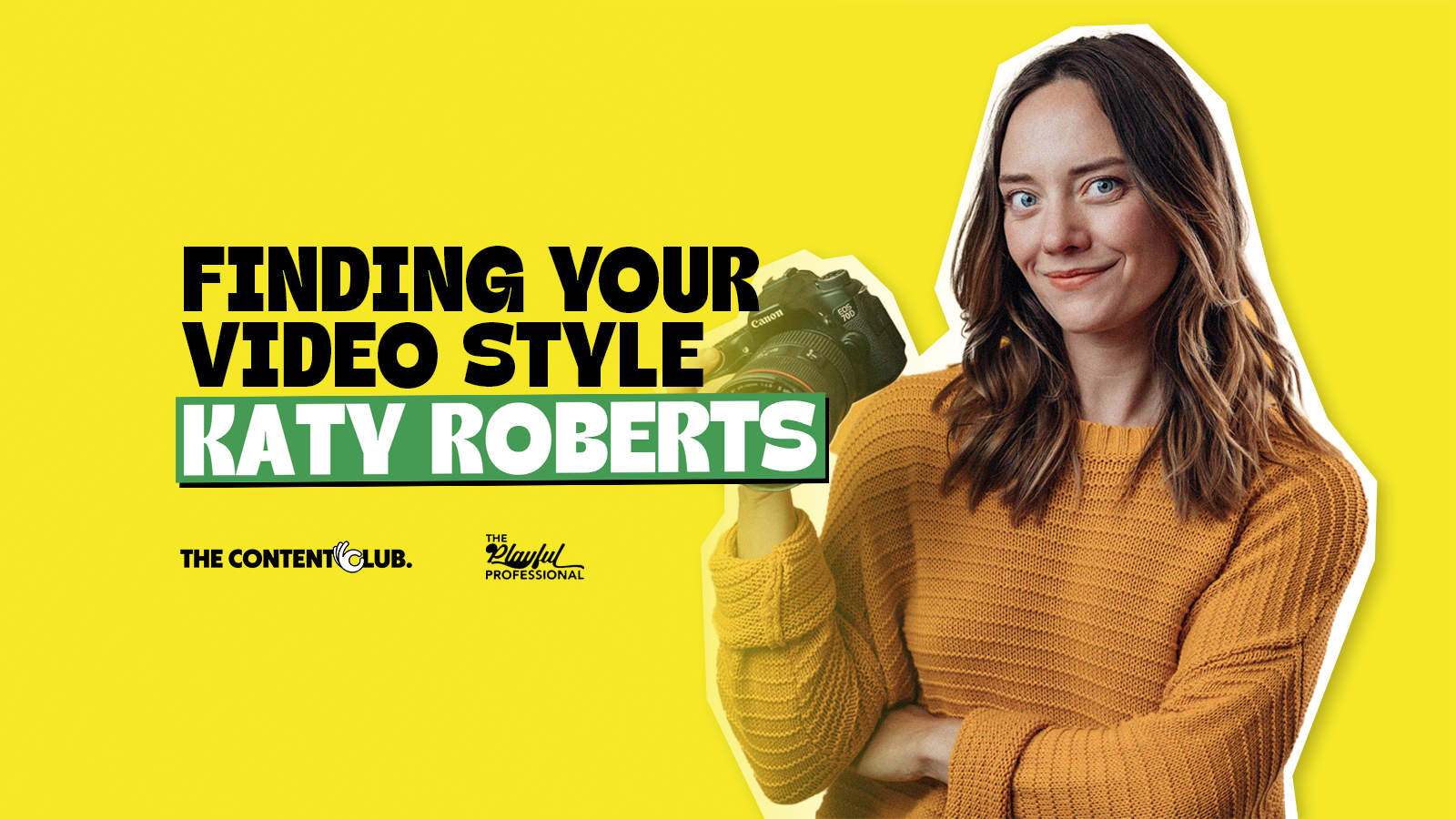
Katy Roberts runs The Playful Professional. She has about ten years in video production and photography, all self-taught, and her LinkedIn videos bring leads into her business. Her stuff is simple and stands out in a feed where most videos look the same. I asked her into the club to talk about style: making videos people know are yours before you're even in frame.
She started with film directors. You can spot a Wes Anderson or Christopher Nolan film from a still. None of them got there by going viral. In Katy's words, fame fades, trends fade, but recognition sticks. She splits a signature style into five parts: brand voice, visual aesthetic, filming style, editing style and predictability.
Start with three or four words
Your brand voice is how you want to be perceived. Pick three or four words that describe who you are and what you want your audience to feel. Katy's are playful, sincere, witty and spunky. She's precise: she wouldn't call herself laugh-out-loud funny, but she is witty. Every other decision comes from these words.
Build it around who you are, not a caricature. Playing a version of yourself is exhausting, and you'll stop showing up.
Limit your colours and fonts
Constraint breeds creativity. Katy's pet peeve is a new font and palette in every video, or seven colours in one. For the text and graphics in your edit:
- One primary colour. Hers is yellow: bright and happy.
- One contrasting secondary colour for when the primary isn't legible.
- Accent colours to draw attention to a word. She uses blue and red.
Pick two or three fonts too: hers are a caption font, a big-text font and an accent font. Expect trial and error, but once something works, keep it. That's what people start to associate with you.
Film in one place and style it
About 90% of Katy's videos are filmed in one spot in her studio. A set place takes the decisions out of filming, and people start to link you with it. When she does film outside, people notice and stay to see why.
Her steps for styling a backdrop:
- Set your main light and build around it.
- Tidy the space.
- Add back with intention, leaving space above your head for text.
- Layer in colour. No sad beige walls.
- Add texture, like a plant or a rug.
- Show your personality with one signature object. For one client, a lava lamp.
Lighting and clothes say something too. Her bright, low-contrast lighting fits "playful". Her signature item is a beanie.
Keep filming easy, make the edit yours
If your style takes a lot of effort every time, you won't do it. Katy keeps filming simple and varies small things: leaning into the backdrop, a foot on the stool, sitting on a rug. Her tip: the best creators she's seen usually show their whole body. It gives you more room in the edit and builds trust.
Her edit is fast. She often ends one sentence as the next starts, so there's no gap to scroll away in, and she cuts the "millennial pause", the beat before someone starts talking. That's her style, not a rule. A slower, more thoughtful creator needs a different pace.
Be predictable on purpose
We binge sitcoms because we know the structure and love the characters. You're the main character, but side characters help: Katy's dog, Chili, gets recognised in the comments. Props work too. A coaching client of hers films with his mic on a skateboard, and she told him to keep doing it. A series gives people something to come back for.
Start where you're comfortable
If you're new, Katy's first step is getting comfortable on camera. Work out whether you'd rather walk and talk selfie-style or script it on a tripod, then build around that. She scripts about 90% of her videos word for word, including the "so"s and "anyways", because she knows how she talks.
Edit your own videos until you know your style. Then write it down in a short style guide, with your brand voice, colours, caption style, pacing and examples, so an editor can make videos that look like yours.
And style doesn't replace substance. If you don't have something valuable to say, it doesn't matter what your aesthetics are.
Katy's takeaways:
- Choose three or four words for your brand voice and filter every video through them.
- Use one primary colour, one contrasting secondary, one or two accents and two or three fonts.
- Set up one filming spot and style it with light, colour, texture and a signature object.
- Add repeatable elements: a prop, a side character, a series.
- Write a simple style guide before you hand your edit to someone else.
Want Jack’s eyes on your videos?
Inside The Content Club you get feedback on your videos every week, from Jack and business owners at your stage, and a clear system for turning views into enquiries.
Read the full transcript
Hello, everybody in The Content Club. I've got a very special guest today who's very kindly, uh, come all the way over from Utah. Very early mornings, 9 AM in Utah, right, Katy? I think I'm right. Um, really cool today, guys, in terms of video style, getting a little bit arty-farty, having a look at some inspiration. Now, um, I'll do a very brief introduction to Katy, but I'm gonna let her do it in a bit more of a deeper fashion in a sec.
So Katy, I kind of found her on LinkedIn maybe about a year ago, maybe January, um, 2025. She runs a business called The Playful Professional. She's a video brand strategist, content creator and a photographer, so she's a bit of a, um, a bit of an everything creative, which is great. 10 years in the video production space, so over a decade of, of doing the thing. For the last year she's been building a personal brand.
Um, what I love about Katy's stuff is it's very aesthetically pleasing. The style is super, super simple, and I think it stands out amongst a lot of the other stuff that we tend to see on, so she feels very, um, it feels very non-manufactured. It feels very natural, which is great. And she's a very small creator that gets very high engagement, so whatever she's doing really works.
And, um, we were kind of having a bit of a pre-chat just to kind of go through stats. Every video, more or less, you know, give or take a few, um, gets a lead in for the business through Katy's content. So it's working for a commercial, which is what we're all about. It's not just creating stuff that's aesthetically pleasing, it's actually creating stuff that moves the needle commercially, which is important.
Ask questions as you want to go, guys, and we'll get to them at the end, and let's have a good workshop. All right, over to you, Katy.
What's up, guys? I am going to share my screen in just a second and we will get started. Okay, can we see that? I can indeed. Great. Okay, so today we're going to talk about discovering your signature video style so that you can take your content from overlooked to unforgettable. But before we do that, I will talk a little bit more about who I am and why you should even consider listening to me.
Um, but as Jack said, I live in Salt Lake City, Utah, in the US. I've been doing video production for around 10 years now, also doing some photography in there, which is really where I got my sense of, uh, my love of colour and things like that. If you've seen any of my videos, you know they're very colourful. But now I run a creative agency where I help other people, businesses, figuring out their signature style and how they can stand out online. But I'm all self-taught, hopefully that gives you some comfort. I graduated from, uh, YouTube University and, uh, just learning everything online, basically, and just a lot of trial and error.
But when I'm not working, I love to ski, I love to hike. I moved to Utah for the mountains. I have a dog, Chili, who is my pride and joy and is indeed later on in this presentation, so that's something to look forward to. Um, this picture is fun. This was my first ever YouTube video, uh, and it was all about styrofoam and why it's bad for the environment, but you can tell I look like a ghost. Didn't really know what I was doing.
Anyways, so when we talk about our signature video style, um, I like to think of it's kind of like finding your personal fashion sense, right? Like, there are certain items of clothing that you put on and you just feel so good in it. People can't help but compliment you, and you have this natural, like, magnetism towards you that people can't look away from. That is what we're trying to build here in your signature video style.
So if we take this beyond social media video, beyond YouTube and LinkedIn, just one step beyond LinkedIn is cinema, obviously. And, um, we think about some of the greatest directors of our time. They all have a signature look, right? I'd love to know in the chat if anybody can name all six of these directors. Do we have any cinephiles in the chat here? Um, I think I lost my chat function, let me look at it again.
Yeah, I can see a couple of people are saying yes, yes, yes. We've got some absolute nerds in this club, so I'm sure there's gonna be plenty of people. Easy peasy. Okay, well, all right, well, um, let's see. We have Wes Anderson, Spike Lee, Christopher Nolan, Quentin Tarantino, Greta Gerwig, Stanley Kubrick, right? So these, even if you don't know the names of these directors, you probably at least recognise some of these screenshots from movies that, generally, like, the style that they're going for, right?
They each have, like, a colour palette that they really like, or a certain type of composition, um, the general themes that they like to get into in their movies. So the whole point of what I'm trying to get to is all of these movie directors have become known for something. The goal of all of this is not, it's not about going viral, it's about becoming recognisable, because fame fades, trends fade, but recognition sticks. There's something very powerful in being known for something, and so that's what we're trying to do when we create our video style.
So there are five elements of your video style we are going to talk about. Mostly get into your brand voice and your visual aesthetic. Uh, we will touch on filming and editing style, but I feel like that's kind of stuff you guys already talk a lot about in this club. And then also touch on predictability. But when you incorporate all of these things together, that's how you create your signature video style that people recognise. They know instantly when, a lot of times, um, people will tell me, "I know it's a Katy video," even if I'm not in frame yet, uh, just because of how it looks, how it feels, all of that.
So we'll start with the brand voice. So your brand voice, this is what I like to call your overall vibe, right? Like, this is how you want to be perceived. It's also, it's going to set the tone for the rest of your video style.
So your video style all centres around your personal brand, right? So obviously it has to do with your business. You need to keep your audience in mind. However, your video style really needs to be more centred on you, because it's going to be exhausting if you're trying to recreate a caricature of yourself.
It's so much easier to centre your style around, like, who you authentically are, so that you can just keep showing up as you are, and it's so much easier, right? So, quick little activity. I want you guys to look at these words, or if any other words, descriptive words, pop into your mind, uh, pick three that really describe who you are. Three to four, right? Who you are, what your brand exudes, what you want your audience to feel, uh, how you want to be perceived. And if you would like, put them in the chat. I'd love to see them, and we'll do that for just, like, 30 seconds here.
I'll do it as well, Katy, I'll get involved.
Love it. "No nonsense, honest, encouraging." I love that. "Playful, calm and existential crisis."
"Playful, fun, direct." These are great. "No nonsense, light-hearted." These are so fun. "Unfiltered, sarcastic, reflective."
Totally. I love that last one, Jack, because it's very, like, it kind of rounds it out a little bit. You're not just, like, shooting the shit, you're like, no, we have a little bit more here. Um, great, I love these, guys.
So mine are playful, sincere, witty and spunky. Uh, so even, like, I'm trying to be very specific about what words I choose, because, like, I wouldn't call myself funny, like laugh-out-loud funny, but I am witty. It's like a charming humour, in a way, you know? Um, but you're not, like, falling out of your seat laughing kind of thing. So little decisions like that, I'm trying to be very intentional about.
And then we're going to take all these words and we are going to bring them to life. We're going to create an aesthetic around them, right? So if we bring it back to cinema one more time, if you think about a Christopher Nolan film here on the left, Christopher Nolan films are usually quite dark. They're very intense, they're very, like, end-of-the-world themes, and so his visuals are like that. They're dark, there's a lot of, like, deep blues, you know, uh, it's like very intense lighting.
Whereas if you think about a Wes Anderson film, they're silly, they're kind of fun and playful, and so they have a much brighter colour palette, the pastels. It's not as much contrast in the lighting. So that's what we're trying to do here. We're trying to bring our brand voice to life. So visual aesthetics entail your colours, your fonts, your filming location, lighting and clothing. I'm going to take you through mine and how I decided on my visual aesthetic, and hopefully that helps you think about what you could do for yours.
So your colours and your fonts. Um, this is where the saying that constraint breeds creativity really rings true, because I'll be honest, one of my biggest pet peeves is when people have, in every video, it's a different font, it's a different colour palette, it's all over the place, or they're using, like, seven colours in one video. And I'm like, what is happening here? It's a little chaotic, right? And it's not telling any sort of brand story.
And so when it comes to your colour specifically, you can do this in your background, you can do this in your clothing, but for this instance I'm really talking about, like, the things that you're adding to your edit, the graphics and the text. It's good to have one primary colour. Mine is yellow. I did that because it breeds, like, happiness, bright, or, you know, bright, excited, whatever. That's my vibe, right?
And then you're gonna want that you have a contrasting secondary colour. So this is the big thing with colours: you always want to make sure there's some high contrast so that it is legible. Um, accessibility is huge online, especially with, like, people who, uh, don't speak your language, or also, um, like, they don't see very well. So make sure you have a contrasting secondary colour that you can use in case your main colour doesn't work in that instance.
And then you have some accent colours. So this is my blue and my red. Uh, these are things I use when I really want to draw attention to a certain word. And there are lots of ways to find your colours.
I'll tell you some tools in just a minute. Um, but I do recommend getting into colour psychology. There's a lot there. I worked with a graphic designer to help with mine, um, and if you do have the budget, I recommend having a graphic designer help you with your colours and fonts specifically.
Um, but she asked me the question of, like, the five senses. It was like, what do you want your brand to look like, feel like, sound like, all these things. For the visual one, I said I want it to look like a box of adult coloured pencils, because I was like, I want it to be very playful and fun, but still organised and still, like, adult, right? Uh, so that's where my colours kind of came from.
Um, and then fonts is similar. Pick two to three and just stick with those. And with all of this, if you haven't done this already, it's a game of trial and error, right? Like, don't feel like you have to nail this in one video. But, um, once you do figure out one that you like, do your best to stick with it, because these are the things that people start associating you with. So, um, I have my caption font and my, like, big text font, and then I have an accent font. So this is, like, if I'm trying to draw attention to a specific word, that's what I use.
Some tools to help you find your colours. Um, Adobe Color. You don't have to have an Adobe account, but this one's really cool if you have a specific picture. Like, if you, uh, even if you're scrolling on whatever social media and you see someone's video and you really like the colours they're using and you screenshot it, you can put that into Adobe Color and it will pull the hex codes out of it for you. And then Coolors is very cool. Uh, it helps you see your colours side by side, and you can lock certain colours and then generate other ones, so you can kind of build your colour palette as you go.
And then to help you find your fonts, again, Adobe Fonts is great for this. You can screenshot. This is, like, one of my favourite creators. I screenshotted her video and then I put that into this program, and it, like, figured out what the font was. And then also, if you're, say you're using CapCut, then you can go on Pinterest and you can literally search, like, "free CapCut font combinations", and people have put in here, like, all of their font combinations that they really like for certain programs that are already embedded into that program, and free. So that's a hot tip for you there.
And one thing to mention is, if you've already done this for your business, for your brand, I use the same colour palette for my personal brand and my business. You don't necessarily have to. I recommend having some similarity so that people associate the two with you. Um, but for example, one of my clients, her brand colours for her business are green and blue, but for her personal brand she's branded as the Agency Queen. And so we added, uh, we added a gold in there to kind of, like, play into that Agency Queen vibe.
So that's something you can do too, to have just, like, an extra colour that's just for you. This is good especially if you have, like, employees or something and you want to distinguish yourself as the founder, a little separate from the business. Okay, the filming location. I love talking about filming location because I'm a big fan of having a set place to film, um, and we'll get into, like, building that together next.
Paul is famous. I did, um, I snooped on a few of you guys, by the way, and, um, I saw, I loved Paul's background, it was great. Um, but once you kind of have your set place, then you don't have to, it takes so much of the, um, decision-making out of content creation, because you have a place to go. It's already set up, it's branded, it's beautiful, and then people start associating you with that place.
So mine is my studio. As I said, I'm a photographer too, so, like, I already had these backdrops, so it's very easy for me to, uh, create that, and it kind of blends in with my brand of being an overall creative, right? But then, um, like this girl here, she's just in her living room, but I think it's cool, instead of, like, sitting in a chair, she's sitting on a desk. It's a little different, it stands out. She's wearing slippers, right? Like, she does that in every video.
Um, Lewis Butterfield, almost always on a children's playground. Um, Paul, just very cool background. I love that you're sitting on a Pelican case. I think that was a very cool decision to make, and, like, I noticed it compared to just, like, sitting on a stool or something. Um, and then I love the composition of this girl's background. It's very, uh, urban, right? She's very much, like, I'm a city girl.
So when we're creating our styled background, so if you choose to do something like me, where I have a place in my house, um, that's, uh, I have a place in my house where, oh, 90% of my videos are filmed there, because honestly, I'm lazy. It's easy. Um, when I'm not filming there, when I do a video outside or something like that, because that's only 10% of the time, people notice. People are like, it's honestly, like, another little trigger for them to be like, "Oh, I know her, she's normally in her studio, now she's outside, what's going on with this? I'm gonna stick around to see what happens." So it's honestly, like, you're feeding two birds with one scone, you know what I mean?
And, uh, but to style your backdrop, I have a little acronym here. So the first thing you do want to do is you're going to set your light. Uh, so you always start with your primary light source. It's pretty obvious. You're going to build around that.
Then tidy the space. So, like, okay, this is CA. He's one of my coaching clients here, and this was his office, and he was like, "I just need some help. Like, I'm in here all the time. Help me design this space so I can film in here."
And so this was so cluttered over here, and I was like, take all that away, take that weird art off the wall, take, oh, like, he had just stuff all over the place. So we cleared it out to make it look like this. And then we added to it with intention. I like to leave a little bit of negative space. For me, it's my back, like, top of the backdrop. For him, I was like, let's frame it so that there's space up here above you, so in case you're the kind of person who wants to put, like, any big text or graphics up there, there's space to do that where it pops.
Then layer in colour. You guys might not be as colourful as me, but let's not have sad beige walls, okay? We need a little bit more. All right, so I had CA put in this stick-on wallpaper, but this can be wall art, this can be, um, honestly, maybe it's your clothing, but anything that kind of adds at least a little bit of colour into your environment.
Um, this can be, like, coloured lights, whatever. Um, and then elevate with texture. So this is, we added the plant, um, anything to kind of warm up the space. So a rug, whatever.
And then the last one, I think the most important one, is to display your personality. So one signature object that really screams you. This could be, again, like, a cool piece of art. For CA, we added a lava lamp. Um, anything that's, if you're like, like I saw on Paul's, he had, like, the film slate. I thought that was cool. That screams, I'm in video production, something like that.
Okay, on to lighting. I will quickly breeze through this one, uh, because I know you guys somewhat know a lot about lighting, but mainly to say, to think about what your lighting says about you. So my brand is The Playful Professional. It's very bright, it's very fun, hence why I have a very bright light and not a ton of contrast. Like, I got a little bit here, but for the most part I'm fully lit up.
Compare that to some of these. This girl, she's a very warm light, a little less contrast, right? Like, she talks a lot about personal development. It's a little deeper, it's a little more, like, in the feels, you know what I mean?
So she has that warmth, she adds that warmth to her videos. Um, this guy is much more, like, cinematic, right? So that screams to me, like, video creator, and, uh, like, talks a lot about video production kind of stuff. Um, this one's a bit more, like, clean and sleek and modern, in a way, right?
So just thinking about how you're using your lights, uh, and what that says about you and your brand. And again, we're always trying to bring those words, that brand voice, to life. And last one for visual aesthetic is your clothing, which is so fun, talking about personal style. Uh, I like to, if possible, think about, again, like, what makes you feel fly? What do you feel fly in? First of all, most importantly.
Um, but if you have, like, a signature item that starts to be associated with you, right? So for me, it's the beanie. I'm almost always wearing a beanie. In the summer, it's usually a bandana, um, something on my head that's very colourful. It's usually paired with a very bright top.
Uh, this girl is always wearing some sort of funky glasses. Uh, this is one of my clients, this is Christine. She's pretty much always wearing red. Um, this one kind of speaks for itself, okay? Uh, you're definitely going to get a lot of attention with a look like that, right?
And then, um, Johnny Harris, he is a great YouTuber, and he is known for his orange coat. And because so many people started noticing his orange jacket, he did a whole video about his orange jacket. Uh, so just some things to think about. Um, I'll quickly go through filming style and editing style, but here we're kind of just thinking about how you're framing, how you're filming your videos, and what's something that you can do that's very you, uh, that you can repeat.
I think a big thing with this, with creating your video style, is, like, you want to create something unique, but you don't want it to be too hard, where it's going to take a lot of effort every time you film, because then you just won't do it, you know? And so for me, I keep it usually pretty simple with my video style. I rely a lot more on the edit, um, which is fine. It's kind of, you know, it's all a balancing game here. And so, for me, I get lazy, and so I'm like, okay, I just, like, I know where to put my camera, I know where the light goes, and I sit in front of my backdrop.
However, sometimes, like, I lean, like, down here, I'm leaning into the backdrop. I'm doing some things a little differently in order to spice it up. A lot of times I'm playing with my stool. Um, I'm sitting on it, I'm, like, I have one foot on it, uh, and I've been playing around with, like, putting a funky rug down and sitting on the floor instead. So it's little things like that, where you're changing up your angles.
Are you, uh, is someone filming you? Is the camera moving with you, or is it still? Um, how far away from the lens are you? Is it kind of, like, a waist-up kind of thing, or is your whole body showing? Hot tip: all the best creators I've seen typically show their whole body. Um, I don't know if that's a thing, but I do think it gives you a lot more, uh, room to experiment in the edit, and it almost builds, like, a sense of trust, in my opinion. Like, you're not hiding anything, um, and you have a lot more ability to, like, use your body to tell your story, in a way.
Um, and then, right, composition. So, like, this is a great way, if you are a film buff, you can get a lot of inspiration from the movies you watch. So I love a Wes Anderson. I'm kind of obsessed, um, hence my bright colour palette, and I'm almost always, like, centre of the frame. I even, like, have some videos that are very much his style.
So editing style, similar thing here, guys. What's your pacing like? Are you kind of, uh, are you more of, like, a, you know, one of those psychology guru guys who really want to, like, make you think? Maybe you're talking a little slower.
And how does your music play into what your audience feels? For me, this is my timeline here. This is typically what my timelines look like for my videos. My pacing is fast, because I'm not giving my audience any time to even think about scrolling away from my videos.
And so I'm usually ending a sentence at the same time that I'm starting a new one, and it's very slight, but if you pay attention, you'll notice it. And so there's no room for millennial pauses, there's no room for any of that in my particular videos. But again, this is my signature style. You gotta figure out what works for you.
But are you zooming in? Are you zooming out? So, like, you know, this girl, she's very poetic. She keeps it super simple. This is what her videos are, but she's such a good storyteller that I almost don't want anything else, because it would take away from what she's saying.
Whereas mine, I'm, you know, it's a little more intense, right? So are things popping in and out? Do you have some animations? What's your vibe? Kind of figure that out as you go.
Did you call it millennial pause?
I did. Um, well, millennial pause, quick side note, is, uh, I think the Gen Zers came up with this, but they did nail it on this one, even though I'm a little offended as a millennial. It's when, um, you have a pause before, it's like your clip starts and there's a pause and then you start talking. So a lot of times it's when, like, you see them turn the video on and then they, like, wait for a second and then they start talking, instead of clipping that part out. When you see it, you'll know. It makes me cringe, for sure. Um, I did a whole video about it, you can go look at it.
But the last part of video style is predictability. So this, honestly, is kind of, like, the whole ethos surrounding your video style: you want to be predictable. That's what recognition is, right? Like, they see you a couple of times, and that's what they come to expect when they see you again, and that's what they're looking for, that's what they're hoping for. When you think about your favourite sitcoms, your favourite TV shows, like, you kind of know the order in which things are going to happen, and that's why we binge Friends and Seinfeld, because we love the structure of those shows, right?
And even more than that is we love the characters. And you are the main character. However, there are still other characters in your videos that you need to think about, right? So in Seinfeld you have Uncle Leo, and in Friends you have Janice.
These are the repeatable side characters who come in every once in a while, but enough to start being noticeable. So for me, that's my dog, Chili. Every time she comes in, people in the comments will be like, "Oh my god, Chili!" Like, they know her, they recognise her, and it's something, like, people get excited when they see her, because she's so cute.
Um, Lewis Butterfield, I think I've just been noticing he's been experimenting with this, like, gorilla costume. I don't know the purpose behind it, but it certainly grabs my attention, and he's done it again and again, and so it's kind of becoming one of his repeatable characters. It's funny, Jack, I put these in before I started seeing your, uh, skits recently with the long hair, the blonde lady, which I love, by the way.
But repeatable characters are great, um, for skits, if skits are a part of your video style, because, um, you can have that one repeatable character. Like, for Jack, it's usually someone who's, like, very ignorant about content creation, and, um, I like how in some of your videos you, like, distinguish them with the same shirt but different colours. And, um, so if that character keeps coming back, especially if they're very noticeable, with, like, a blonde wig, that's super fun.
Um, you know, these two, these two are doing videos together all the time, which is funny to me, and, uh, they're brothers, and he's always, like, the villain, um, which is very fun to me, and they're just, like, making fun of each other. I don't know, but it's videos that don't happen super often, but enough where I notice.
Um, okay, symbols and props. So similarly, this is similar to, like, your clothing and stuff. It's things that are constantly popping into your videos. Uh, I love how this guy has his mic on a skateboard.
Like, that's so fun. And he's a coaching client, and the first time I saw that, I said, keep doing that, keep doing it, because people are going to notice that. And he's a skateboarder, and so I was like, okay, then go, like, start filming stuff while skateboarding, safely. But it's, like, now skateboarding is kind of becoming a part of his brand, but this little thing is what popped it off, and I love that.
Um, this is one of my styling clients. This is the Agency Queen I was talking about, and so this crown is very much becoming a symbol of her brand, and so we try and bring it into her videos as much as possible. Um, do you use props, like a whiteboard, um, or a flip chart, whatever it is? And then, if you guys follow Chloe, she makes great videos, but she, uh, uses a wand a lot to talk about things, and she'll, like, point to things on screen and then, like, stuff will pop up. But that is very much her and part of her brand now.
And then, lastly, repeatable stories or content types, also known as series. So this is actually a great way to start establishing your brand, because aesthetically it's going to be similar, but also thematically. And if it's a series, it's something that people are going to definitely be looking forward to and coming back for, um, because they want to see more things like it. There's a reason we love TV series, right?
So, like, if you guys, I don't know if you guys follow Tim. He brands himself as, uh, the Mr Rogers of LinkedIn, Mr Rogers of corporate America, that's what it is. But he always starts his videos with, um, the hook, and then he says, "Hi, I'm Tim," and then he goes into the next thing. It's very soothing, honestly. He's, like, he's like the dad everybody wants. But, uh, one type of video he does all the time is "A dope-ass Sunday in your 40s", and it's, like, his version of a day in the life.
But, uh, I look forward to seeing it every time. So it's like he always goes, "This is a dope-ass Sunday in your 40s. Hi, I'm Tim," and then he goes into the rest of the video. But, like, that's stuck in my head for a reason, you know, because he's doing it over and over again, and he's known for that now. Um, again, another Content Club edition here, um, building in public. Super easy way to create a series, especially for LinkedIn.
I tried to do this. I have an informal building in public series, but I haven't been as structured as, like, "Week 39", which I'm very envious of, because I think that's very cool, and again, something people can look forward to. Um, then also, this is Milky Train. Her stuff is hilarious. It's on Instagram, but I recommend it. "Three adult things that happen to me this week." It's chaotic, but it's fun.
Um, but yeah, then, lastly, really, is a little bit of homework for you. Um, your first homework assignment is, next time you're scrolling, um, we all do it, is to scroll with a little bit more intention, right? So when you do see something you really like, save that video. I have a whole, like, folder in my Instagram account, my TikTok account, all over the place. Like, I have a Notion board with people I'm inspired by. And make a note to yourself: what is it that you love about it?
Like, Marina Williams is this great photographer, but I love her videos. I love the font she uses. I kind of stole her yellow. And, uh, Patience is another photographer, actually, but her pacing is so good.
So it's like I'm taking little things from each one and blending it all together to create my style, because that is, you know, we all do it, right? I'm sure you've heard the saying, "steal like an artist". There's no such thing as originality. You're just taking little things from all different people that you're inspired by and creating your own thing.
Um, and then, but even beyond that, so we're saying, like, the TV shows you're watching and the movies. Like, I get really inspired by, like, I love the colours here, I love the composition here, I love, like, the patterns, and also how, like, she's so small and it's, like, this massive thing. So, like, mural art, photography, whatever. I would say just keep your brains and eyes open for any form of inspiration, because you never know when it's going to hit.
And then, lastly, I would say your main form of homework is to make your own video style mini brief. So when it comes to your video style, the main challenge we run into, especially once you graduate from creating your own content to giving it to an editor, is a lot of times what you have in your head never matches up to what they give you, because we don't have this clear direction of, like, how to edit your videos, right? So a style guide is very helpful with that.
And you can have your brand voice on there, how you want people to feel when they're watching it. You have your colours, like, this one's the caption colour, and, um, you can have your caption style, preferred pacing, all these things, and then examples of videos of yours that you like, along with, like, inspiration from other people. Um, but I have a, which we can also send a link to afterwards, but this is a Canva template. Uh, you have to have a Canva account. You can have a free account to fill it out.
Uh, and then it's a thing that you can give to an editor, or just refer to on your own when you're making your own stuff, to remind you, like, what colours you use, what was the hex code, whatever. Um, and then also follow me on LinkedIn, because I'm talking about this stuff all the time, and, uh, you can get inspiration from my videos, and just be my friend. But that's it, guys.
That's amazing, Katy. Thank you so much for an amazing presentation. I think it's a unique one for the club, because I am, uh, I'm very commercially minded in terms of how I approach videos. I've always got to lead someone to the next stage, and it's always funnels and sales systems, the geeky, unsexy stuff. So it's nice to tap into something that's a little bit more artistic, you know, a little bit more aesthetically pleasing, because I do think, to a degree, it has, uh, a big impact.
Um, I think if you can create a style that aesthetically stands out amongst other people's, especially on LinkedIn, where everyone's is kind of the same, and other platforms, maybe TikTok is slightly different because you have a bit more creative variation, um, it does support the business. That's from my experience, and obviously it works for you as well, which is great. I did see a couple of questions here. Um, so guys, if you do have any questions for Katy, now is the time. I've got 20 minutes left, which is pretty good timing, um, to pop them in.
So if you have any burning ones, please do. I just wanted to ask you too, Katy, then I'll get to the questions in the club. First, how long has it taken you to kind of establish your style, or is it an ever-evolving thing? It's just good for context of how long things can take, you know.
It's definitely an evolving thing. Um, my obsession with colour has happened over time, for sure. Um, establishing my, I, again, I love colour, so, like, I started with my brand colours and I was like, how can I bring these to life through my, uh, what I'm wearing, what my surroundings are, things like that? Um, but it really, I don't, this might not be helpful at all, but, like, I tried something and the internet liked it, and I was like, okay, well, that wasn't that hard, I'll do that again.
Um, but yeah, it has kind of evolved over time, but I would say, like, it took me a few months of trial and error of being like, okay, I'm gonna have, uh, this is what my backdrop is going to be like, this is how my, a lot, the hardest part is figuring out the edit, of being like, how is my text going to come in, what kind of music am I going for? Now I know exactly. When I hear it, I'm like, okay, it's usually, like, you know how you can put keywords in? Um, mine is playful, mysterious and, uh, well, sometimes, like, children, which sounds creepy, but, um, or jazz, or retro too.
So nice. Like a bit of jazz, like a bit of jazz myself. Um, now, for people who are new to creating videos, and maybe they haven't got that style yet, maybe they're focused on more of the messaging and, you know, what that system looks like, what is the first thing to do? Obviously we've covered quite a lot of ground in terms of the aesthetics, the colours, the psychology behind the colours, the text, the structure, the pace. What is the first thing that you feel would be easiest to get into to start to identify the style, or is it something that just does happen naturally over time?
Um, both. So, but the first thing, actually, is, I think, establishing, it goes back to that brand voice, and a lot of that comes with your delivery style. And I think getting comfortable on camera is 100% the first thing to figure out. And in what setting are you comfortable? Like, do you prefer, is it easier for you to just, like, grab your phone and put it selfie-style and walk down the street and talk, uh, compared to setting it up on a tripod and doing a whole scripted thing? Um, like, or do you prefer to have a much more structured approach? You gotta figure that out first, because that also sets the tone for the rest.
Like, I script 99% of the videos that I make, because now I know my brand voice so well that I write exactly how I talk. There's all those little, I call them, like, the informal transitions. It's the "so"s, the "and so", like, "yesterday", "anyways". It's all these little words that we say naturally that we might not put into a script, but we probably should, uh, because that's just going to help it come out more naturally. So yeah, I would figure out, like, where you feel most comfortable filming and how you feel most comfortable filming, and then work around that.
Do you script word for word your videos, or do you bullet point?
Um, it's, like, 90% word for word, again, because I know exactly how I speak, and so it makes it easier. And I can now, I do it so fast now. Like, I mean, scripting takes me a minute, just to figure out the actual meat and potatoes of what I'm trying to say. But, uh, when I'm, you know, a 90-second video will take me 10 minutes to film, just because I can kind of run through it.
How many videos do you reckon you've created in the last year on LinkedIn?
Uh, the last year, I'd say at least one a week, so 25, maybe.
Okay, that's pretty good. It's just good for context. Anybody listening live or watching the recordings: 25 videos, almost a year of creating stuff. That's how long it takes to just kind of get to the foundations of…
Well, yeah, 25, probably in the last six months, I would say.
Yeah. But then I guess before that you've had a decade of making videos as well, so you've got a lot of that, right?
And before this, before I discovered LinkedIn, because I didn't think about LinkedIn at all. Like, I think, like a lot of us, it wasn't really on our radar until either someone put us onto it, or, for me, it was, I was one of the rare ones who did go viral on there, back when that was possible. Um, and I could have left it at that, but I chose to capitalise on it, and I started creating videos based on that one, and then it kind of grew over time.
Um, but before that I was making stuff mostly on Instagram, and that is probably how my aesthetic started. It is much more, like, Instagrammy compared to LinkedIn, obviously, um, which is probably why it's doing so well on LinkedIn, whereas on Instagram it's just kind of one of many. Um, but that is why, I mean, I know a lot of you guys are on LinkedIn, but I think if you can nail a unique and interesting-looking style, you will shine brighter than 99% of the people on there.
Totally agree, totally agree. I think we had this conversation as well in the pre-chat, guys, in terms of where it's at. LinkedIn, obviously, is a very small platform compared to lots of other ones, right? There's lots of other ways you can do this: YouTube, email, go TikTok, go whatever, MySpace, I don't know if that's even around. But there's lots of other ways you can do things. LinkedIn is just a small thing, but because we're all B2B, B2C, um, it's, like, the place to do it, right?
And the opportunity now is massive. If Katy's been able to do it since January, uh, I've been doing it since 2018, whenever that was, um, like, if Katy's done it, there's opportunity to do it now, right?
I think it's just style. I got really focused on style.
I want to come to the guys' questions here, Katy, as well. So Yuri here has said, "Curious to hear your opinions on Yassin's videos." I think he means the guy who runs, is it, Viral Video Club, Yuri? Um, that rings a bell.
I will ping it here, Katy, in the chat for you. This is his LinkedIn. Um, I'm interested in this as well, Yuri, because, uh, his content is basically just brown, dark, quite dingy, but very, very yellow pop of text. Very, um, Quentin Tarantino kind of style, um, all the nerds watching. Um, so I'm interested to, yeah, I think you might be right, by design.
But yeah, Yuri says he's keen to hear your opinions on Yassin's style of content, and whether it is intentional, whether it's just because he's incredibly successful at what he does, is it laziness? I don't know.
So the first thing that I know, I have seen a few of his videos, um, is his lighting's very nice, um, which to me screams that he knows what he's doing on video, and he has a video club, so that makes sense to me, where he wants to look at least professional in that sense. Um, if you compare that to my brand, where I use a phone, one, because I'm lazy, two, um, I am very much giving off the idea that anybody can do this if you implement a few key things, right?
Um, but I think that he, I, yeah, I like the, the main thing is he's consistent, honestly. Like, that is, I think, the main thing here. He uses the same font, the same colours, um, in pretty much all of his videos. I love the composition.
Um, he probably has, like, a very consistent pacing and tone of voice, right? Like, he's a little cheeky. Uh, it doesn't have to be super bright, crazy colours like mine. Again, he's leaning into what works for him, and it's not the same for everybody.
I agree, I totally agree. Um, next question was from Paul. I think it was from Paul, I saw it. Uh, yes, it said, "Do you edit all your own videos, Katy?"
Great question. I used to, up until, like, two weeks ago. So I edited my own videos for years and years. Um, I'm an Adobe gal, so mostly Premiere Pro and After Effects. Um, and then it was, like, a month ago where I realised that it just wasn't sustainable for me, um, because it just took me too long. So I hosted an editing competition on LinkedIn and found an editor who's saving me so much time. And, you know, I haven't seen the ROI yet, because it's only been two or three weeks, but, um, I think it will be really helpful in the long run.
So, but I will say, I always recommend editing your own stuff until you figure out what this style is, because a lot of it happens, uh, like, I even have to do it when I give feedback to my editor, of being like, I don't know what I want until I see it. And so I have to get into the edit and play around until I kind of figure out what I like. Um, and that happens over time. And now I have, I mean, it's, like, a 20-page style guide that I give my editor, and that's part of the business that I run, is I, like, create these style guides for people. Um, but now, honestly, any editor who's decent could edit my videos, because I have dissected them, and it's, like, the anatomy of a Katy video.
That's great. I think it's super crucial. Um, you'd be surprised with how many founders will hire people, professional people, to do the job, but they have no idea what they're trying to do. Um, I used to experience that in the agency world as well.
Um, yeah, and I've done both sides. I've been a freelance editor, and obviously now, like, worked with editors, and the key to working with an editor is to be as, um, specific as possible, and communicative if possible.
So totally agree. Um, Yonen here says, um, "On the one location thing, whilst I understand it from a practicality point of view, isn't it a bit dull to repeat the same location every time? I tend to think I've already seen the video before I scroll." I agree, just interesting point.
Yeah, that is an interesting point, and so that's where all these different elements start to come in, right? So, like, one of my clients, the Agency Queen, as I was talking about, she uses the same backdrop every single time. However, she changes up her outfit every time, and she's usually wearing something bright and colourful. It's very noticeable that it's different.
So that's a way you can do it. I like to pop in in different ways. You don't necessarily have to just be seated in the same place, static. Um, play with your environment a little bit, even if it is the same environment.
And then this also comes down to, you know, your hooks. And aesthetics are always going to be a part of your videos, but honestly, more important is the actual content and what you're saying and the value that you're bringing. And you have to have both to be successful. And I know I've been talking about aesthetics this entire time, but if you don't have good content, and if you don't have something valuable to say, it doesn't matter what your aesthetics are.
Paul has also said, "How do you come up with ideas for photography slash creative content? I struggle to find topics that are videography-relevant but interesting enough for a wide audience."
So I'm a big believer that your best ideas come when you're least expecting it. I have to turn this, uh, this Yassin video is, like, in my peripheral view, just going off, and I can't concentrate. Um, but I keep a running list on my phone. I call it, um, story storming. And, uh, I literally stopped in the middle of a mountain bike ride the other day because I had this idea come to me and I had to write it down. If you have any ability to, like, take two minutes to write down your idea, I definitely recommend it.
But, um, most of my videos are story-based, and so it's something that's happened in my life that, honestly, you can always tie back into your work at some point. Like, use ChatGPT. That happened to me once. I took my dog to rattlesnake aversion training, and I said, "I got really cool footage, and this is a really cool story. How does this relate to, like, video production?" And it gave me ideas about, um, like, not being afraid, or conquering your fears, or whatever, uh, but it was more about business.
But yeah, anyways, the main thing is to just keep a running list. And, um, once you start getting yourself in the mindset of noticing ideas, uh, it's positive and negative, because then you're like, oh my god, everything is content. But it is helpful. Um, once your brain is open to that, you'll be amazed how you'll be like, oh, that's a good idea, oh, that's a good idea. But you just have to write it down. That's the biggest thing.
It's very true. We had a meetup yesterday in London, and my advice to a few people was just say, just try and film everything that you can at every possible opportunity. Um, because even though you might not use it immediately, when you think about it, it's just good visual context to kind of look back on and use to show the transformation or the journey, especially for, like, building in public stuff. I think it's really important. But just have a folder on your desktop or on your phone or somewhere that you just store this random assortment of clips, um, because you'll never know how important it is to you, to just have that to hand sometimes.
Um, and even just flicking through it sometimes, you can get ideas and those sorts of things. But I like the story, I like the story approach. I think that's really cool. Um, one or two more here. So, uh, second to last one, from Jules. He said, is it okay, oh, hang on, I didn't say that, so I put that in my own words. He said, "As a note of consistency, is it okay to shake things up after a period of time, say once a quarter, just to keep things fresh?"
A hundred percent, yeah. There's no reason that it has to stay the same for the rest of your life. Like, I would say, um, keep it consistent for a certain amount of time, just to make sure that, like, if it does start to stick, then, um, even if you do want to switch it up a little bit, like, keep elements of what people liked. Uh, because people always talk about how they love how colourful my videos are.
That's never going to change. I make sure to be really colourful in all my videos. But yeah, maybe at some point I'll switch up how I do my captions, what my font looks like. Um, but I would just say keep it the same for a certain amount of time, and don't do it, like, every video, you know.
I think so. I think it's important. I think you get the data of what does and doesn't work as well, Jules. I think, um, if you just stick to the same style all the time, you're maybe going to get the same results all the time.
Um, try a landscape one, try something long-form, try a YouTube video that's 15 minutes long. You know, just experiment. I think especially everyone in the club, it's, you know, it's not even been a year open, so it's a good, um, gauge of time. Everyone's very early in the kind of days of creating stuff.
Katy's been doing it for 10 years, a year on the personal brand side of things. Six or seven years personal brand, started from my side. Um, and I can guarantee you Katy isn't, like, making the same stuff that she used to make 10 years ago.
Honestly, even, like, two years ago. Yeah, to give you just a quick example: I shot this video, so when it was very popular online, it was, like, top tips for filming outside. But I spent an entire day filming this thing. I was, like, hanging from a tree, I was running all over the place. It did very well, but afterwards I was like, that was exhausting, I cannot repeat that. And so that's one where I'm like, every once in a while I'm gonna go out into the real world and film something cool, but that's gonna be a one-off, and people will notice that it's a one-off, and that's great. But it's not gonna be, like, my core signature style.
I agree. I've just filmed, over two days, a music video for the length, and it looks amazing, but I said to you before I dropped in this, I am knackered. Absolutely knackered. Last weekend's just killed me. Um, but no, I agree, testing different things is really important.
But again, it's crucial, guys, you know. It comes down to, um, getting your message, getting your offer and everything sorted out first. Aesthetics alone can move the needle to a degree, um, but you've also got to do some of the unsexy stuff as well first, to kind of make it work a little bit harder. But when you've got all the groundwork done, everything that Katy's gone through is super applicable, and, um, start to implement it, because I think it will really help to push the visuals and get the word out and spread the message and break the noise.

Built his last business to £1M a year, then started The Content Club to help business owners turn their expertise into videos that bring in customers.