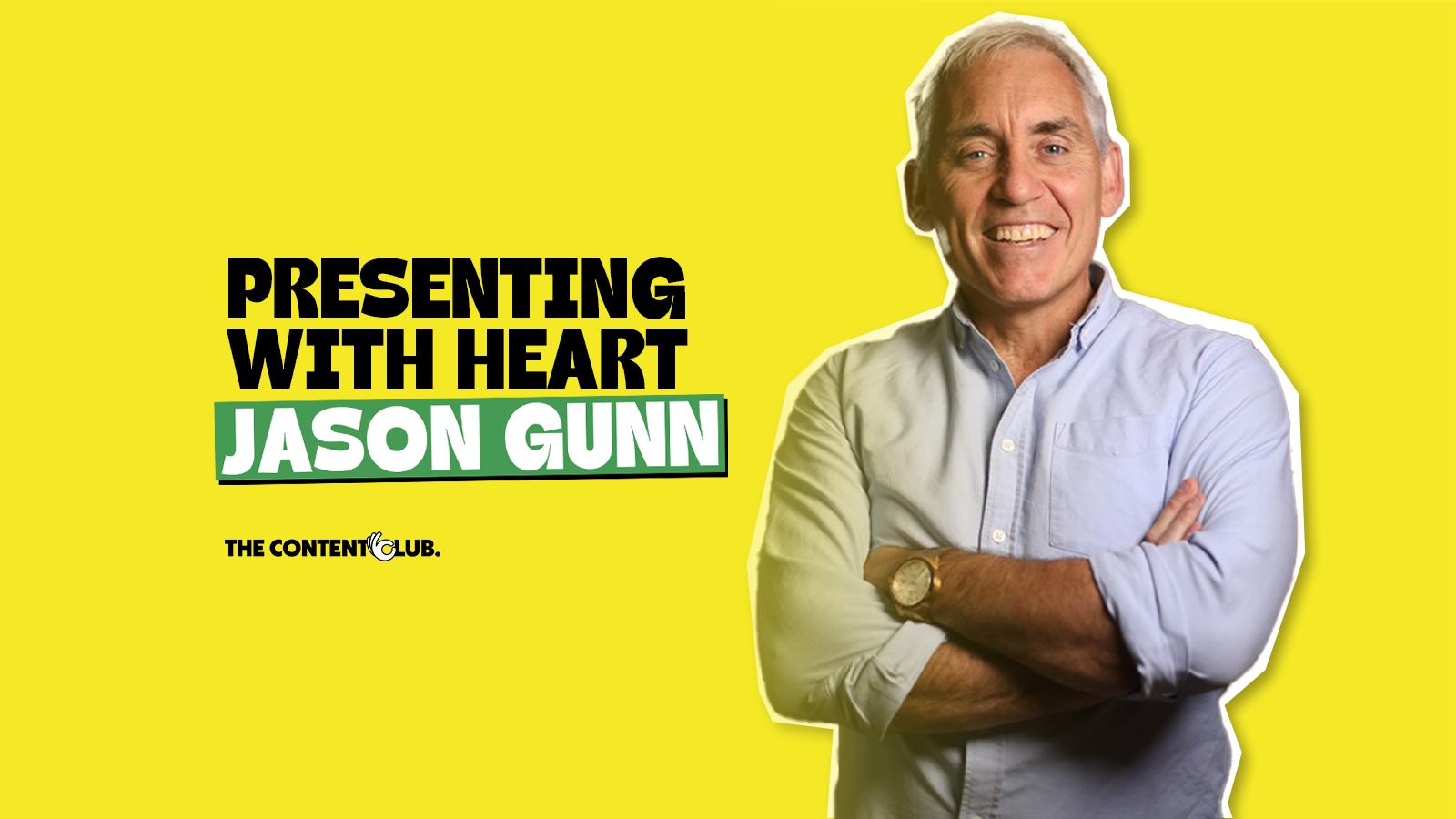
Jason Gunn got his first job in New Zealand children's television at 18 and has been presenting for 35 years. He now runs Easily Said, which helps people communicate better. He closed our 2025 workshops in the club with a session on presenting with heart: how to stop performing for the camera and start connecting with the person watching.
Talk to one person
On kids' TV, Jason never opened with "Hi everyone". He asked what sort of ego assumes everyone is watching. Instead he talked to one kid: the one coming home from school after a bad day, letting themselves in and switching on the telly.
That's the secret he wanted members to take away. You want millions of views, but you're only ever talking to one person. Pick someone you like, picture them down the lens and have the chat you'd have over a coffee. Lean in. Use your hands. If you say "um", carry on.
The HEART formula
Jason's formula for communicating is five words:
- Heart. Say what you mean and mean what you say. It has to mean something to you before it can mean something to the viewer.
- Empathy. Before you ask "do you see what I see?", ask yourself "do I see what they see?" Where are they at?
- Authenticity. Rate your confidence on camera from 1 to 10. Jason's job as a coach isn't to turn a six into an eight. It's to make the six comfortable being a six. Share your bad days as well as your good ones. Forget perfection and aim for connection.
- Reassurance. Start by naming the viewer's problem, then give them a roadmap from where they are to where they want to be.
- Tell stories. Facts and figures get forgotten. Jason once told a group of cricket players a story about his mum instead of showing them charts. Two years later, a young bowler came up to him and still remembered her name.
Keep a journal or notes app for them. Anything that makes you feel something is worth writing down.
On nerves, Jason was honest: he still gets self-doubt, judgment and imposter syndrome. To him, that just means you care. And it isn't about you. You're the messenger, and the message is for them.
Use traffic lights for pace
A flat video loses people. Jason wants variety, and he plans it with a traffic light:
- Orange is most of the video. A comfortable pace, maybe a little slower than you'd normally talk.
- Green is a short burst where you take it up a notch: more volume, more pace. Stay there too long and it becomes noise.
- Red is the pause. Say the thing that matters, then stop and let it land. It also gives you a moment to think about what comes next.
He bullet-points his talks rather than writing them out, then marks them up with red, orange and green markers. If there's no red or green on the page, go and find some.
Look at the lens, then look away
First, look at the lens, because that's where your one person is. Never at the flip-out screen.
Second, don't stare at it. In real conversation we break eye contact every five to seven seconds without noticing. Lock onto the lens without a break and you look like, in Jason's words, a Netflix serial killer. Glance away when you'd naturally think, then come back. And move: shift in the frame, lean back, lean in, use your hands.
Review in three passes
A producer taught Jason this when he was 18. Watch each video back three times:
- Sound off. Visuals only. Are you moving? Is it too much or too little?
- Sound only. Can you hear the orange, the green and the red?
- Both together. Does it all work?
Be honest, but kind. Don't change so much that you stop sounding like you.
Before you hit record
Jason's three questions: what's the one thing you want your person to know, to feel and to do? If you've got too many things you want them to know, you've got several videos, not one.
Then skip the kit. Jason's most-watched videos were shot on his iPhone, even with a cabin full of gear. Every minute spent fetching lights, tripods and mics dilutes the idea. Find a spot where nobody will interrupt you, pick up your phone and record.
His last point: nobody runs a half marathon without training. Treat the camera the same way. The first ones will be rough. Do the reps and get camera fit.
Want Jack’s eyes on your videos?
Inside The Content Club you get feedback on your videos every week, from Jack and business owners at your stage, and a clear system for turning views into enquiries.
Read the full transcript
Hello, everybody. Good morning to the final 2025 expert-led masterclass or workshop about presenting with heart. I've got an amazing, amazing man with me today called Jason Gunn, who runs a company called Easily Said, which is all about helping people to be able to communicate better. Okay, I'll let Jason dive into all the nitty-gritty details in a little bit.
I've brought Jason today. I've known Jason for probably, actually, I'd say since starting the first ever agency, V21. So it's probably been five, six, maybe more years, I think. Jason used to prevent… He spent 35 years in children's TV and some big New Zealand shows, hence starting this a little bit earlier, because he is over in New Zealand.
What is the time where you are now, Jason? Just out of curiosity.
It's 9.02 PM.
Fine. Okay. So it's 8 AM here. So you're 12, 13 hours ahead. Okay. Fine. So it's quite a big difference there. So thank you for jumping on so late. So Jason, the floor is yours, sir.
Good golly gosh. Well, thank you. And good evening from New Zealand. Or as we say, kia ora is our official native way of saying hello. So kia ora and good morning to you. It's a weird thing, isn't it? The whole time travel thing.
But of course, you may be watching this at another time of the morning, evening. I do not know. So I hope you are well. And I hope everything is sort of going well as we sort of come to the end of this year. I always say as I get older, the days seem long, but the weeks seem short. And I can't believe we're here. But this is really, really special.
So thank you for having me. I, first of all, applaud you for wanting to improve your video making. I just think that's wonderful. I think in these crazy times of AI and everything going on, I think this, the ability to connect, you'll hear that word a lot from me this morning, this evening, wherever you are. You'll hear connect a lot from me because that really is what we're trying to do.
And in these crazy times with AI, human connection is everything. Our ability to do this and connect is a superpower. You know, our ability to read a room or just think, what does this person really want from me, need from me? So a little bit about me. So Jack's given me a hell of an introduction, which is great.
But basically when I was 18 years old and I got through high school, which I hated, it just wasn't for me. Just my brother, different story, but it's not about him tonight. So I hated high school, got out and 18, I got a job in children's television, which was the ultimate job. Now in New Zealand, you know, the children's television is like at the ass end when it comes to, you know, levels of importance. You've got your news and your current affairs and your entertainment and little poor cousin, which is children's television.
But what I didn't realize at the time is that children's television is where you learn everything. Like you have to be good at a lot of things. And as you can imagine, right, making children's television, there's a lot you can't talk about. So there's a lot you have to just put to one side and just talk about this.
What's the one thing I want to talk to you about the most in this session is what I learned in children's television is you look down that lens. So do we know where the lens is? Good. We look down the lens. No, it's all right. No, because it's amazing how many people don't. We look down the lens and we talk to a person, a person, not many people, a person.
I never went on afternoon children's television and said, hi, everyone. How are you? I thought, what sort of ego does a person have that they think everyone is watching? So I would always talk to that one kid, one kid that would come home from school, maybe had a bad day like me when I was younger. Maybe they've come home and there's no mom or dad at home.
Maybe there's no mom or dad, but it's the early nineties. So the house is probably unlocked safely and they let themselves in and they turn on the television and there is Jason Gunn. And I'm there every day for them. And I will say, hello, you. How are you? Great to see you. You are the best part of my day. I've been waiting for you. And I have this one chat with this one person.
How do I know this is powerful? Well, I guess when you live in a little country, New Zealand, like New Zealand, it doesn't take much to be well known. If you made a bit of tally, people go, oh, is that going off the television? And you know, over the years, I've had lots of people come up to me and say, oh, hey, Jace. Oh man, I just, thanks. Thanks for being there in the afternoons.
And two weeks ago, this guy stops me at the airport and he says, hey, Jason Gunn. I went, just don't need the full name, mate. Just Jason will be fine. I feel like I'm in trouble. Okay, Jason. I just want to say, mate, he said, I had a pretty dark childhood. Like it wasn't great, but he said, and I've never met this man before.
And he sort of reaches out and he grabs my hands and I'm like, are we having a sound? It's like, what's going on here? And he just holds my hands and he said, I just want to say, mate, like you really bought the sunshine on some of those dark days. And I really want to thank you. And I get emotional just thinking about it.
I don't say that to impress you, but to impress upon you that we can all be that for someone, right? By simply leaning into this camera we've got and not talking at people, but talking with people and even not people talking with a person. So if there's one superpower that this has, and you should always do with your video, you want millions of views, but you're only ever talking to one person. That is the secret.
And you've just got to not look at the camera. Just think, who is that one person? And who's it going to be? Think of someone you like. That's always good. Don't pick someone that really annoys you. Think of someone you like and look at them down that camera and have a conversation with them.
And when I say have a conversation, it's just like I'm trying to do now. Like this is how we would chat if we went out for a coffee. You know, I'm not sitting back here too far. I'm leaning in and I'm chatting with you and I'm using my hands as I naturally would. Have I said um or ah? Probably. Do I give a rat's ass? No, I do not.
It's about authenticity. It's about just being real and having a chat and leaning in like this with people. So what I want to do, God, Jason, get on with it. What I want to do is talk you through my formula I have for communicating with people. Five words. And then I just want to just dive down into the actuals of talking to a camera.
So feel free to write these down or, you know, I can, we can get some notes to you, however you want to do it. Here's the five things. I've actually got an acronym, like I'm going to give you a word and then magically five other words will appear out of nowhere. So the acronym is HEART. H-E-A-R-T.
Um, it's a very important acronym for me because I say HEART and seven years ago I had a heart attack. Um, so I, I don't use this word lightly. Uh, it's, it's always also a reminder for me when I say this, that Jason, are you looking after yourself? Are you looking out for yourself? So that's it. We all need a heart, right? And we've got to look after it.
So here's what the five words are. The first, the H, what does it stand for? Bit of a cheat because the first H or the H stands for heart. That is the word you're thinking. Oh, wow. What a cheat. So what do I mean by that? When we speak like this and hopefully you can feel it when I'm speaking to you, we're going to speak with heart, right? And what does that mean? It means you've got to say what you mean and mean what you say.
There was this wonderful U S president who was really good when it came to speaking. Obviously no longer is he president. I think we could all agree on that. I'm just saying, I'm just saying possibly someone who's currently president may not be getting quoted for a speaking in a hundred years. I'm just saying this guy was Teddy Roosevelt and Teddy Roosevelt had that beautiful phrase, which you probably have already heard of, but it's my favorite. No one cares how much, you know, until they know how much you care. And I'm like, Oh my God, that to me is everything.
So when you're making a video for me and I'm watching it and you're trying to tell me something, maybe sell me something. I need to see in you that it means something before it can mean something to me. Otherwise, why should I get, why should I care if you look like, yeah, anyway, so hi guys. Hey, so today, that's how I'm going to feel. Am I going to watch the end of the video? No. Right.
So we can talk about video styles later. Sometimes you can cut up a video. I'm not going to cut once as we chat. Hopefully you stay with me. Hopefully. But it's that idea that I'm going to speak from the heart. You are going to see how much this means to me. And only then can it mean something to you. That's the age.
The E is for empathy and understanding this one person I'm making this video for. Where are they at? Like, what are they going through? What's going on in their world? I have this beautiful phrase that I use whenever I speak on stage or on camera. And it's this. Before I ask someone watching. So do you see what I see? Do you see what I see? I need to ask myself, do I see what they see?
So if you're trying to teach them something, think, where are they at? What are they going through? What are they struggling with? It may be different to you. So just, you know, just maybe you can ask your audience. It's great when you ask them, what do you need help with? And boy, will they tell you. And then use that. Use that to go, hey, I've had this coming or someone's asked me this question.
And it's just that empathy, understanding. It's never about us, right? It's about the person we're talking to. Have empathy for them. Actually, speaking of the current American president, I had a beautiful story about Kamala Harris. Let's put all political opinions aside. But I heard this beautiful story.
A young girl came up to her during the campaign and said, do you get nervous before you speak or go on camera? And we can talk about this soon. But I mean, I don't know about you, but I do. I get nervous before I talk on camera or anything. Three things will happen. You'll get self-doubt. Have I got this? You'll feel judgment, like these people watching and I'm like, who's this loud guy from New Zealand? Really? Is that the best Jack could get? Right? And then you'll get imposter syndrome. Like, am I the best person to be? Really? Am I the best person? Surely someone else.
Here's the good news. If you get nervous, if you feel those emotions, I love you. I love you. Because to me, that says one thing. You care. The day you don't get nervous, the day you stop worrying, the day you don't feel a bit of self-doubt, imposter syndrome or judgment, that's the day, excuse my friends, you've officially become an ass. And that would never happen to you. I don't think it would. Right? So don't worry about worrying. It just means that you care.
Anyway, Kamala Harris said, no, actually, I don't get nervous before I speak on camera or speak in person. The little girl said, how is that? And she said, because it's never about me. And the little girl was confused. And she said, what do you mean? She said, I simply have a message that I think this person needs to hear. So it's all about them. Right? I'm just the person passing on the information. It's all about them. Right?
So you go, wow. She said, she said to the little girl, imagine I could put you back on the Titanic. I said, oh God, don't worry. She said, I'll get you off in time. But she said, I'll get you one job. I'm going to put you on the Titanic. And your job is to tell everybody this is going to happen. It's about to get real. Here's what you need to do. Right? The little girl goes, okay.
And Kamala Harris said, hey, tell me, would you worry how many times you said, um or ah? The little girl said, no. She said, would you worry about forgetting your words? No. Why not? Well, good God, woman, I've got this message that I need to get to these people. They're counting on me. Exactly.
And that's where we tend to go wrong. We make it about us. We start thinking, oh God, I stopped there or I stuttered or I forgot. I'll just go back and start again. And look, if it gets ugly, yep, start again. But generally it doesn't. And it's very, very authentic when you make a mistake and you forget and you move on. And that's what you should do.
I always want to see you um and ah or go, now what was that thing? What was, oh, I remember. You know, it happens every day in real conversation. But if you're worrying about that you're making about you, you've got to make it about them. That's the empathy.
The A is for authenticity, one of my favorites. And that is you just being you, right? You being you. I always ask people when I'm coaching them, what are you on the scale of communication confidence? One being, I don't want to talk. And 10 being, I love to talk, Jason. Don't make me stop talking.
In fact, I don't know if we can now, Jack, but we may have a couple of people with us now. A lot of people will be watching this at a later date. But can I just ask, are you able to maybe just talk via Jack to me and just what do you think you'd be when it comes to talking on camera in terms of confidence? Would you be a one or a 10 or a 20? I know some American people who are definitely a 20. Bless them, by the way. What do you think you'd be like?
Jack's a solid eight. I like that. And I believe that too. Seven. This is a solid seven from Nick as well. Not just any seven, a solid seven. Appreciate that. This is nice to know. This is good. Paul, is that a six, Paul? My eyes are not what they used to be. I think it's a six. That's definitely not you. It's my eyes. But it's a really fascinating thing.
Thank you so much, by the way. It's fascinating to look at this and think about what you are and where you sit. And all I'm saying to you, if I was coaching Paul and Paul was a six, the first thing I'd say to Paul is my job is never to make you an eight or a nine. My job is to make you feel so damn comfortable being a six. If you're a one or a two, you probably don't even have the guts to type in one or two. You know, it's like, here we go.
That's a great point. Jason and Jack both need to get to speak. So it's a good point. It's a very good. I've got to get the eyes fixed. Need a bigger scream. But that's the key thing. We don't want you to be faster, funnier, more clever. Just, you know, it's like, you just got to be you being you, right? Just whatever number you are, just be that.
Stuff everybody else. There's other funny people out there or just whatever, you know, or people who are more confident, just authenticity. Tell your stories, share your experiences, share your good days. Here's the most important one. Share your bad days, right? In this crazy world that we live in right now, your vulnerability and your authenticity with that is, it's just everything, right?
I see so many people appear on YouTube and I go, excuse me again, that's bullshit. Like that's not you. No one is like that. G'day guys. How are you? Just all tickety-boo. Triumph of perfection. We don't want perfection. We all want connection. I didn't know that was going to rhyme, but it did. Please write that down.
Forget perfection. What does perfection look like? It's filled with errors. You know, that's the reality. It's just, you know, that you're never going to get it perfectly right. So that's authenticity. Be you. Don't try and be a version. Don't watch Gary Vaynerchuk. Don't watch Tony Robbins and go, I'm going to do that. Tell your stories your way, right? Get famous for being you, not a bad version of someone else.
The R is for reassurance. And this is a whopper. So many people are going to watch your videos because you're going to reassure them, right? You're going to make them feel better. They've got a problem. If they didn't have a problem, they might not need to watch your video. I'm just saying, but they've got a problem and you're going to help them fix it.
You know, one of the best ways to reassure people is to point out first that they have a problem. Great way to start. Are you someone who hates that? Do you ever feel like for me, it's like, you ever stand on front of a stage or get in front of a camera and feel like I just can't do this. They should have got somebody else. Does self-doubt just ruin every good speech for you? And people are just going, yeah, yeah, I'm here to help. I'm going to show you how to fix that.
So you start with the problem, right? And then you reassure and you reassure and you reassure them. You give people a roadmap. You say, here's where you are and here's where you're going to get to. So reassurance.
And the final T is for telling stories, which I know storytelling is such a buzzword, but it's so, so true. It's so, so true. If you'd allow me, I'd like to, well, I've got a couple of stories that I love to do to explain the power of storytelling, right? And it's because it's facts and figures are great, but we just forget facts and figures. So when you're making videos, just ask, well, what story could I tell?
So I do a bit of work in Australia with Cricket New South Wales. And I go over there and I was talking with some of the managers and the players and the coaches. I love my cricket. And I went over there and I was told that, Jason, could you talk to the players with one key message? It's bigger than cricket. I said, what does that mean exactly? Because I love my cricket and not much to me is bigger than, what do you mean by that?
And I went, well, you know, our players are focused, a lot of them are focused on, you know, winning and trophies and stuff, but we're trying to double the number of young people playing cricket and Cricket New South Wales. And to be brutally honest, and this is, this is just the truth as it is, who gets their kids into cricket? A lot of mums. Do mums want to go and watch their kids play cricket? Hell no, they don't. And I don't blame them because it's a long day watching your kid fail and then sit around doing nothing. Trust me, I've been there, right?
So they said, what are we going to do? We need to remind them it's bigger than cricket. That's not just about the winning. But what the hell do I talk about? So I thought I got over there and I thought, oh, well, what do I talk about? I could get some pie charts out. Everyone loves a fancy bar chart or a pie chart. No, I'm going to tell the story.
And this is the story that I told them. And it's just for me to show you the difference between facts and figures. I could show you some facts and figures now on cricket and why it's bigger than cricket. And I'd assume you'd switch off now, go to the next video. Here's the deal. I told them the story.
I told them the story about my beautiful mum, my mum, who sadly passed away two years ago. And that's a journey that I am still on and I hate, but it's a journey that many of us are on, will be on. If you are anywhere on a journey like that with anybody, I'm sending you big love because tough times, but one day at a time is how we do it. Right.
So I said, here's the story. Three days before my mum passed away, she calls me on the phone and says, now listen, I need to tell you, we never talked about mum's illness. We didn't know it was three days till she was going to be gone. We never talked about the disease that started with C. We never talked about palliative care. We never talked about the end.
My mum rings and says, darling, the nurse came in last night and she wanted to talk about the end. Well, you could have knocked me over. I was like, oh God, we're going to talk about it. So mum's on the phone like this. And I'm like, okay, mum, I'm going to hang up. I'm going to FaceTime you.
So I hang up. I FaceTime mum. I go, hi mum. Mum, you need to bring the phone around the front because she's still got the phone here. You know what? You may know someone slightly older than you in the family who holds the phone here for a FaceTime call. So she brings it round. I go, hi mum. And I go, so talk to me.
She says, well, this nurse came in last night and she bought a cup of tea. I was like, okay, details, mother. What did she say? Well, she wanted to speak to me about the end. And I was like, and did she? Yes, she did for about 40 minutes. She talked to me about the end and what's going to happen and that sort of stuff.
And then I asked the question that no son or daughter wants to ask their mum. Mum, tell me how it's going to end. What's it going to be like? And that's when my mother, Janice Rose Gunn said to me, to be honest, darling, I wasn't really listening because the cricket was on. And I said, what the hell are you talking? Are you shitting me? What? She said, did you see the cricket? Wasn't it good? Wasn't it good? She said, Australia, New Zealand.
And I told these players that. Why did I tell them that? Because I said, I know you love to win, but do you know something you don't know? You have the ability in playing cricket to make a woman 87 years old with three days left to live feel like life is beautiful. You give her the most amazing gift of escapism. She feels like this is as good as it gets. And three days later, she's gone. Now that is not better and bigger than playing the game of cricket. I don't know what is.
Did it go through? Did it sit? Did it resonate? Two years later, I'm there. And this young Australian bowler comes up to me. I don't really remember the guy who comes up. Apparently, he's going to be the next big thing. He says to me, oh, hi, Jason. I had to say, your beautiful mum, her name was Janice, right? And I went, oh, my God. Yes, mum. They're saying your name here.
He said, I just want you to know. I get emotional thinking about it. He said, I've never forgotten that story about Janice. It's the most beautiful story. And he said, and yeah, and thank you for reminding me of why I do this. Sometimes I forget. He said, on Saturday, I played a game of cricket and there was kids were lined up with signatures. And I thought, oh, that's enough. The hand's getting sore. And I just looked at these kids and I thought, it's bigger than cricket. And he said, what would Janice say? Stick around, sign some more.
So why do I share that with you? It's just a story. But I could have told these players some facts and figures about why they need to do more for children and people. And they wouldn't remember it. Two years later, that beautiful young man remembers my mum's name, right? That's the power of storytelling.
So let's just pause for a minute. Heart. Speak from the heart when you make your videos. Have empathy. Where are these people at? Authenticity. Am I being myself? Like, am I being kind to me? Am I letting me make mistakes and just carry on? And reassurance. How can I reassure people? How can I help them go from where they are to where they want to be? And T, tell stories. What's a story that would explain this best?
And what I'd suggest to you is you should keep a journal or open an app. And you should just start looking for stories because there's stories everywhere. Sometimes there's someone else's. Some guy called Jason Gunn the other day told me a great story. Oh, no. Write that one down.
You'll see people every day. You'll see and experience things that make you feel something. Did that moment in the shop, did it make you talk into that person behind the counter? Did it make you feel like, oh, that was just beautiful. Did you overhear a conversation that make you feel sad? The stories all around you, write them down. Heart, empathy, authenticity, reassurance, and tell a story.
Now, I just want to go a bit further. But before I do, I just, because, you know, you can tell, I love to talk. Are there any questions or anything that's, have I put you to sleep? Is there anything that's come up so far that you might want to, oh, Andrew, thank you so much. Blown away. But thank you. I really appreciate that. Thank you. But is there a, oh, you are gorgeous. You are my kind of people. Thank you so much indeed.
You know, here's the thing. You know, I talked about being nervous and judgment. How can I say this without sounding arsey? Okay. So, so in New Zealand, small country, you know, a few people get to know you. I hop on this call. None of you are going to know me, which I love, by the way. I love. And I would hate that my business is ever based on, I grew up watching Jason. I don't want it to be that.
But you need to know, I've done this for 35 years. And before I sit on this call, and you know, when you're making Dancing with the Stars, which was Strictly Come Dancing in the UK, you know, for a country of 5 million people, a million people would watch. And I don't say then to go, ooh, I just go, so it could be big numbers. I have the same self-doubt, imposter syndrome and judgment, starting here, talking with you right now. And that's fine. I just, I just lean into it. I hope that at least one person on the call likes me, takes something from me.
And that's the other thing quickly I want to say to you is this. Not everyone's going to like you. Not everyone's going to like what you do. Stuff them. Stuff them. You just, it just, it just, it just doesn't matter, right? It just honestly doesn't matter.
Yeah, that's, that's a great point Nick makes. It's that, it's that whole idea of like, you know, I always go, you could be vanilla with your video, mate. Go on, be vanilla. Make a video that doesn't really sort of resonate with anyone. You know, no one hates it, but no one loves it. Is that what success looks like? I don't know. Be memorable, eh? Be memorable. Make videos that some people talk about, that some people love to watch and other people choose not to. Do that. Piss some people off. It's all right.
You know, I, the reason I love Jack's videos and all the stuff he has on content. It just, to me, it's like, you know, I love that. Yeah. Nick says I'm a huge fan of being bold in content. I love that, mate. It's be memorable. It's like, look at Jack's videos. It's how did I start? How did I first connect with Jack?
I saw this guy and he was making videos and I followed Jack's journey of like the agency and having gear and having people and then stepping away from that and being very vulnerable, like some beautifully vulnerable videos, mate. And then it just, and then rebuilding and doing that. I go, I like that guy in a, in a noisy world. He stood out. Why? Cause he was authentic. He spoke from the heart. Here we go. He was empathetic, authentic, reassured, and he told good stories. Probably didn't, probably didn't actually know he was doing all that, but he was.
Um, okay. So I guess one of the things I really want to talk about is in terms of making videos, there's something I'd love you to do. It's a little exercise. You have to do it now, but you might want to write this down. It's something to think about is, um, there's an art to every video having a bit of this, right? We don't want a flat line. Like it's got to have, it's got, it's just got to change. It's got to be like a bit variety. That's, that's the word Jason struggling to come up with, but he's just remembered it and he didn't stop and start again either. He kept going. Um, so a bit of variety, right? And away you go up and down.
How do you do this? Well, here's what every video of yours should have, right? Think of a traffic light, red, orange, and green. I know that you know that, but here's what most of your video should be in orange. What does that even mean? Orange is a nice color. Orange is just, it's maybe a little slower than you'd usually talk, but it's at, it's at a pace and it's at an energy that you could talk for a long time and people could listen to this for a long time, but it's screaming out for something. It needs something else.
You're like, what does it need? I'll tell you what it needs. Since you asked, I'll tell you what it needs. It needs a moment of green. Green is where we just for a minute, we just take it up a notch. We get damn excited. What are you thinking? We just increase the volume. We increase the pace. We do something. Listen to me.
And I don't know who's watching this where, but if we go green for too long, we become what I would call an American. And there is nothing wrong with, I know there is nothing wrong with that because I love the way they've got energy. Just for a lot of New Zealanders, that can be a bit much. And I know what you're thinking. That is rich coming from this man, but go with me. So it's a moment of green, right? And then back to orange.
And then you continue in orange with your video. You're chatting away and chatting out. But at some stage in this video, you're going to do what? Have a moment of red. Moment of red. And what is red? Red is to stop. Red is to pause. And just let it sit. The power of the pause.
When I say to you something like, when I say to you something like, do you know what? I'm so, I can tell you a story and I'm telling that story my mum. It's like, and I say, look, and my mum passed away a couple of years ago. That's a big thing to say. I'm not going to go, yeah. And as well as that, because you know what, with mum passing away two years ago. Yeah. It's like, whoa, whoa, whoa, whoa, whoa. You've got to have that, give people that moment.
It might not be that someone died. It might just be a really important thing. If there's whatever you're teaching people, you might be going, the one thing I want you to know is this. And I'm slowing it down and I'm going into red and I'm going to say it. And I'm going to sit there with the silence. And you're like, you shut up with your silence. But in that moment, it lands.
And this moment, you go, shit, I should write that down, what he just said. Or he stopped talking. That last thing must have been important. And I'm allowing you to digest what I said. Two things happen when you pause. Number one, you go, wow, yeah. Number two, if we're making a video, it also gives us the chance for the brain to go, right, shivers, where are we going next?
You know, don't spend too much time in red. Otherwise you are now delivering a eulogy can get a little heavy, just saying. So you bring it back to orange. But what I say to people is when you sort of bullet point your script, not a fan of writing everything out, what you're going to do is this, get out a red and orange and a green marker. I've been doing this for years and I still do it.
And on your little bullet pointed speech, your talk that you're talking to camera, you're going to go, hmm, here we go. Where am I orange? Oh, here. Where's my moment of green? Good God, here it is. And where's my moment of red? There it is. And I guarantee some of you may have early on no need for the use of your red or green marker. And we need to fix that, right?
And someone just commented beautifully about, yes, green. Hi, people who come on and sell stuff and you're like, shut your mouth because there's just noise, right? It's just, and you are gone. Would you give it 10 seconds? Probably not, right? So look for the red, orange and green moments when you talk, right? And just go, aha, right. That's how it works. You need the red, you need the orange and you need the green. That's what you need. Moments of it. If you haven't got it, go and find it.
Now, the final thing is a couple of things, but I'm really passionate about. Is there any questions from that, by the way? We've got time for some questions at the end, if you have any, or if you're watching this later, so it's recorded, good luck with asking me a question and me answering it. Just saying. Anyway, here we go. But I wish we could have that technology, right? Oh, you are, Nick, you are so kind and possibly drunk. That is so kind of you, Nick. Thank you, mate. I really appreciate that. I really, really do.
So here's something that I see when people have online meetings. All right. I like you. Here's one thing that people do. I love an online meetings that people just, they get into a frame like this, right? And they don't move. And I go, I can't tell if you're still, if you're breathing or if you're buffering. I don't know what it is.
It's like, and it's like, you'll notice I'm going to, I'm going to use this, right? It's like now, Jules, you are very lovely, but seriously, we need to get you out more. You are lovely. You deserve better, Jules. So it's about, it's about this. It's about when you're making your videos, just make sure you do move freely.
But here's my two top tips for talking to a camera. That was tips, by the way, my two top tips for talking to a camera. First of all, this is unsimple. Number one, look at the lens, obviously, because that's where our one person is that we're going to connect. It's interesting on online meetings, how people do this. They're like, hey, good to see you guys. Anyway, it's like, why is you looking at my breasts? Like I'm not there. I'm, it's just see, oh, there you go. So make sure, you know, you look there.
Also the same, when people often have a camera, they flip that little screen around the side. Don't you dare. Don't, don't you frigging dare look at that monitor. Don't you dare. Nothing says, hi, you're not as important as me. There's someone looking at that flip out screen. It's just, how dare you? Right? So this is where I am. This is where you find me.
Oh, but here's the second top tip. Don't look at the camera. What the hell does he mean? Here's, here's what I mean. Right. If we're having a chat in real life, me and Jack, we're sitting here, we're in a cafe, we're chatting away, especially if it's someone you don't know that well, I'm going to look at you and I'm going to be chatting away. And without knowing it between five and seven seconds, you're just going to look away and then you're going to come back because there's something in us. Every five to seven seconds. We just, we just do that.
You don't even know you're doing it. Sometimes you do because the person's just a bit stalky, but generally you don't know you're doing it, right? But it's a natural thing. We break the gaze. We just do. We also do it when we do stuff like this. Now, listen, I, oh, what's the name of that guy? I look up, I look out. God, I can't remember.
Like I haven't spent the whole time looking at you like this. This is very Netflix serial killer, right? This is, it screams, I have bodies in the basement. This is what this says to people, right? So naturally you do this and you look away and you come back.
Nothing worse than we get on camera, lock in. G'day guys. How are you? So I want to talk to you today about my new course. It's like, what's wrong with his neck? What's he not looking away for? What's, where are the bodies in his basement? You need to just look at the camera and then just occasionally just look away.
Now I'm going to be watching your videos for a while now. I don't want to see you. So hi guys. It's like, no, Jason isn't saying we're not Zoolandering it. We're just subtly looking away when it makes sense. We're breaking the gaze as you would naturally. When you go to think, oh, what the hell is that? Oh, I can't even think just that sort of thing, right? So break the gaze because if you don't, it all just, it all just gets a bit odd when you're just literally eyeballing the camera and you never, ever look away.
Once you start looking at people on camera, you'll go, oh my God, that's what it is. The three things they're probably not doing in their video. Number one, they're not moving. They're quite, hi guys, how are you? And you think, maybe the head is just pasted onto the shoulders. Like they're not moving. They're not moving in the frame.
You know, if I want to do something, I may need to lean back and show you this, or maybe I've got to lean forward. Oh, my Mac computer has that stupid thing it does where it follows you. But ignore that because most good cameras don't. But you know, sometimes you want to use your hands. I once heard someone say this. This is all very good. This is pillow talk. And listen to me, sweetie. We're not there yet. Okay. So we can have this little chat for a bit, but we've got to come back here. Right? So you've just got to, you've just got to use the camera. You've got to look at the camera and you've got to look away from the camera.
And the final thing I want to say to you, I promise this is the final thing, is this, is you've, you've got to review. Like I made television for a long time. My reviewing system was cruel and unkind because I'd go on television and people would write to the papers and go, that Jason Gunn's a dick. That was my review. That's people would write to the TV guide. I hate that Jason. Okay. Right you are.
And I'd watch back a VHS tape. I know I've lost some of you when I say that. And I'd watch, and I'd watch me back and go, I'd review me and go, okay, what am I doing? Like we're always our harshest critic, but I'd look at it back. And this one producer said to me a long, long time ago, and I thought it's such a great thing. And I've heard others say it, but I just know I learned this trick when I was 18.
And basically he would give me the tape to watch back. Of course, now you don't need a tape. You can just do it on your telephone. And I'd look at it and he'd go, okay, now, before you look at it, what I want you to do, he said, I just want you to look at it with the sound down. I went, what the hell? So you'd just watch the picture, turn the sound down and just watch it.
And you'd look at you and go, God, he's a, he's a busy boy, isn't he? With his gestures and what's going on there? And he's, but what do you look like? What do you see? Like, is it too much or is it too little? Are you moving? Is there anything in the way you're just moving? And you remember it's on mute. Is there anything in the way that you're moving that makes you go, yeah, I'll watch to the end of this?
Then you do the opposite. Go to the start, play it back, but you don't watch it. You just listen to it and you go, oh my God, is that what I sound like? But listen, have you got this? Is there the traffic light? Is there a moment of orange? There's no green. Oh, that's a little bit of red. You're listening for that.
And then the third time you watch it back with both and then you go, and does that work when we combine the two? But you've got to watch it back, honestly, and then listen to it back and then watch and listen to it back. And you've got to critique yourself. You've got to be kind though. No, most of us don't like our voice or the way we look. That's fine. Remember what Kamala Harris said? It's not about us. We've just got a message. We're the messenger.
So be honest with yourself, look at it back. And if you want to share it with somebody else, great. But, and I'm not saying I'm good at this at all, but how have I got better? By making so many frigging mistakes and just going, oh, good God. Just, oh, oh, oh, oh my God. This is, this is how you get better.
And the one thing I'm going to say to you is, is this feels very authentic to me. I just feel like I'm talking just to you. I'm not talking to anybody else on this call, idiots. I'm only talking to you, obviously, right? As for those other people, I don't know, right? So I'm trying, but this is me, honestly, how I'd be.
If you met me, and I'd love that to happen, as long as you pay the Fs. If you met me, I would be just like, sorry, and you wouldn't, maybe you'd want one drink and then go, that's enough. But I'd just be like this. This is the authenticity. This is Jace. Love me or leave me. And thankfully, most of you haven't left yet. That's how I would be. So I just want you to lean into that as well.
When you watch yourself back, don't make massive changes that all of a sudden make you not you. You know, don't, don't do that. At the end of the day, like I said earlier, if you were a two or a three, there's a billion twos or threes out there. And they love seeing other twos or threes. It makes them feel good. So you just be you. Authenticity is such a key.
Watch yourself back, critique yourself, but be kind. And then just go, okay, how can I, how can I be better? And you'll always find a way, you know? And I've made so many videos that have never seen the light of day. And that's fine. They just, and Jack's probably the same. It's like, nope, no one will ever see this. And that's okay as well. But once you get to a certain point, you will, this whole process will become so, so easy and you'll get so good at it.
It amazes me. People say, I'm not good. I could never go. No, I'm not good on camera. And I go, oh, okay. Just tell me about yourself and we'll get chatting. And I go, so you've done a half marathon. And I go, yeah, no, I did a half marathon. Yeah. I go, so like at the very start, did you think, did you know you could run? Oh no, no, I'm not a runner. Right.
But you didn't ever say to yourself, I'm not doing a half marathon. You just went, I guess I should do some training. And then you trained and wow, whoopty woo, look at you. You did a half marathon. These are the same people though, who will turn on the camera and just start talking and wonder why it's crap and still post it.
You know, it's, you've just got with the marathon model. Yeah. You've just got, you've just got to train and train and fall over and feel like you want to throw up literally and then go again and go again. And then you get good. Camera fit as I would call it. Right.
So boy, oh boy, that has been 45 minutes of me just talking with you, hopefully not talking at you. There's lots of other stuff, but I just thought, look, I don't want to bombard you. Think of that. Remember the heart thing. Remember that heart thing, heart, empathy, authenticity, reassurance, and telling stories.
Remember that one person, that one person you're talking to on camera. Who is that one person? Name them. If you want to put their, put their photo beside the camera, but obviously look at the camera, but really think about that one person. Think of the traffic light. Am I being orange? Am I being red? Am I being green? Where is it? Right. And just remember that message. It's for them. It's not about us. No one's judging us. We don't give a shit if they're judging us. We're here with a message for them.
And you know how I said that was the final thing. There is one other thing I want you to write down, if you could, before you make a video. And it's this. So many videos I see are too busy. Too many ideas. People go, I can't remember everything. I go, that's because you're trying to remember too much. And in real life, you wouldn't remember that.
So I've got three questions I want you to ask before every video. And it's this. What is the one thing you want that one person to know at the end? What's the one thing you want that one person to feel? And what's the one thing you want that one person to do? Just one. What do you want them to know? What do you want? It's not 10 things. It's not five. What one thing do you want them to know? I can fix. If you've got this, I can fix this.
How do you want them to feel? Maybe reassured. Do you want them to feel worried, concerned? What is it? And what do you want them to do? Sign up to this. Click here. Do as I say. But simply ask yourself, what's the one thing I'm asking? I want them to know, feel, and do.
And then when you look at your script or your thoughts, you'll go, yeah, there's a lot going on here. And if you've got lots of ideas, do you know what that gives you permission to do? Make lots of videos. Not one with lots of ideas. Congratulations. You've now got 10 videos in your head. Just one simple video at a time.
That is enough from me. Boy, oh boy, you'll be exhausted. Your ears will be burnt. Hopefully, that's given you some confidence to just get out there and try some stuff and know that we all get nervous. We all fear failure. But you just think stuffer. Just give it a crack and you'll just get better. Yeah.
So please, honestly, if you've got any questions or there might be something we didn't cover or there might be something where you go, this is all great, Jase, but do you know what? It's like there's something that else that holds me back. What is that? I mean, we've got time. If you want to chat about it, let's have that chat. Jack?
That was hands down, I think one of the best presented workshops we've ever had in the club. Just the way that you recite and deliver information is so impactful. I've wrote so much stuff down as I usually do, but I've got pages and pages and pages and it's actually helped me as a video creator who's been creating videos for a long time. I love the traffic light system. I tend to just be on green all the time. Energy, energy, energy, energy, energy.
I know what you mean, but I've seen some orange and red in there as well, don't you?
Okay. Okay. So I think it's made me aware, which is great. So even I've learned something new, which is great. I love the ending of the marathon analogy as well.
And quick story from my side, I was speaking to someone in the club this morning. We mentioned this before we went live as well, just between Jason and I, who was looking to buy some extra courses and to dive into some sort of influencer guides about how to really level up their YouTube game. And if you are watching, don't worry, I won't call you out. And I just said, you just need to do the thing. Stop investing and buying new stuff and buying new kit and trying to learn from the best of the best of the best.
Just make the next video and then focus on making the next video a little bit better and then doing that next one a little bit better, just based off of what you've tried already. And sometimes in life, I think we try and add very complicated solutions to very simple problems. And that simple problem is just do the thing and learn through doing and learn through practice. Right. But it's takes a long time. And I think, you know, you've been doing this now for 35 plus years, Jason. I would imagine you weren't as good as you are now as you were on day one or day 20 or day 100.
Actually, a lot of green at the start. A lot of green.
Yeah. Interesting. So we just learned through doing, guys. And if Jason is an example here, stick at the same thing and be great and leave your legacy and leave your reputation for one thing. And you're going to become one of the best in the world at it.
So I actually haven't got any questions because you answered everything as we went through, Jason, which is rare for me. So I do have, there are some, there is one here which goes against the point of just getting started with what you have. And, you know, but I'm going to ask it anyway. Jules said, what is your camera setup? It seems to be following you slash keeping you central.
Oh, yes. Well, I see. Isn't that funny? I, I'm not a fan of it. My actual camera setup is actually on my, I'm actually on my Mac at the moment. I'm in the process of building a little studio. I mean, I don't want to move it too much, but I've actually, we've got a little, we live on a, a 10, it's called a 10 acre life style block. I call it a 10 acre life sentence block, but that's another story for another day.
So in, in the one of the, in the back paddocks, I built a little cabin and in the cabin, I have this little room here that I'm in the process of doing that. And there are, oh, there's lights in the corner. So I'm, you know, it's good. And I usually have, in fact, there are many cameras, wait, there are many cameras just sitting badly on the floor that should not be like that.
Classic example though. I look at the, my setup and what I've got and I'm trying to find my phone, but it's gone. Oh, there it is. My most watched videos, all shot here, all shot on this cinematic mode on the iPhone. Oh, and I've spent tens of thousands of dollars on gear. Sorry, in case my wife is close, a little bit of money on gear. Do they get me what I want any more than this? No, they do not.
The great thing about this too, is you're used to looking at a phone, right? You get the camera, you get the light. Here's a great thing. You've got a good idea thing. I'm going to video that, Jules. You should video it. Where you go. I'll just get my light. I'll get my tripod. I'll change my battery. Actually, I'll just get this. I'll just get my mic. The idea is diluting. It's going. It's going. It's going. And then you finally go, right. Okay, cool. Actually, I don't give much of an ass about that idea or I've forgotten it.
Whereas the phones are great because you go, I've got an idea. Bang. Camera, portrait, go, boom, record. There's something to be said for that. Also, if you're ever out and about, recording with this is much, much, much, much easier. Thank you, Jules. It's diluting it. That's what we do.
The more we put it off, it's a bit like when I see people who do lots and lots and lots and lots of takes. You know what it's like. Take one. I'm really into this. I need to tell you about water safety this summer. Because sorry, I shouldn't say it, but in New Zealand, we are. I'm so sorry. I'm so sorry to rub salt into your winter wounds, but we are heading into summer here in New Zealand. So there's a lot of water safety, right?
So it's just that idea of like, right, okay, I'm going to talk about water safety. Right, cool. And I'll just get my gear set up. And you go, oh, God. And or take one. Oh, shit, I stuffed up. Take two. The importance of water. Oh, shit. Take three. The time you get to take 15, I don't give a rat's ass about water safety. I'm just, I just want to go home. Whereas the first time, if I can just get it out and be kind to myself, today we're going to talk about water safety in New Zealand. That little thing I did then, we do it all the time.
So don't worry about the setup. Yes, I've built a little setup here. I think it's quite cool that I can do it. I have got some lights, so I just switched the light on and it's ready to go. It doesn't need to be this, but if you've just got a place that you can access quickly, I shut that door. I have four children. They're all grown up, but they still come to visit. Dad's recording. So they know this is my space. Give yourself a chance for this to work.
If you sit on a park bench and do that, you will attract seagulls and people playing bagpipes or with weed eaters. They will find you. So all I'd say for a setup, Jules, is create an environment where you can just be you and people aren't going to interrupt you. But for goodness sake, there's no need to spend too much money on the gear like some of us have.

Built his last business to £1M a year, then started The Content Club to help business owners turn their expertise into videos that bring in customers.